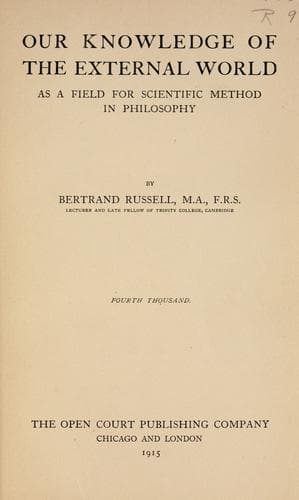
Our Knowledge of the External World as a Field for Scientific Method in PhilosophyRussell, Bertrand
Philosophy
Our Knowledge of the External World as a Field for Scientific Method in Philosophy
Russell, Bertrand
Knowledge, Theory of; Logical atomism
In the mental world, the evidence for the universality of causal laws is
less complete than in the physical world. Psychology cannot boast of any
triumph comparable to gravitational astronomy. Nevertheless, the
evidence is not very greatly less than in the physical world. The crude
and approximate causal laws from which science starts are just as easy
to discover in the mental sphere as in the physical. In the world of
sense, there are to begin with the correlations of sight and touch and
so on, and the facts which lead us to connect various kinds of
sensations with eyes, ears, nose, tongue, etc. Then there are such facts
as that our body moves in answer to our volitions. Exceptions exist, but
are capable of being explained as easily as the exceptions to the rule
that unsupported bodies in air fall. There is, in fact, just such a
degree of evidence for causal laws in psychology as will warrant the
psychologist in assuming them as a matter of course, though not such a
degree as will suffice to remove all doubt from the mind of a sceptical
inquirer. It should be observed that causal laws in which the given term
is mental and the inferred term physical, or _vice versa_, are at least
as easy to discover as causal laws in which both terms are mental.
It will be noticed that, although we have spoken of causal laws, we have
not hitherto introduced the word "cause." At this stage, it will be well
to say a few words on legitimate and illegitimate uses of this word. The
word "cause," in the scientific account of the world, belongs only to
the early stages, in which small preliminary, approximate
generalisations are being ascertained with a view to subsequent larger
and more invariable laws. We may say, "Arsenic causes death," so long as
we are ignorant of the precise process by which the result is brought
about. But in a sufficiently advanced science, the word "cause" will not
occur in any statement of invariable laws. There is, however, a somewhat
rough and loose use of the word "cause" which may be preserved. The
approximate uniformities which lead to its pre-scientific employment may
turn out to be true in all but very rare and exceptional circumstances,
perhaps in all circumstances that actually occur. In such cases, it is
convenient to be able to speak of the antecedent event as the "cause"
and the subsequent event as the "effect." In this sense, provided it is
realised that the sequence is not necessary and may have exceptions, it
is still possible to employ the words "cause" and "effect." It is in
this sense, and in this sense only, that we shall intend the words when
we speak of one particular event "causing" another particular event, as
we must sometimes do if we are to avoid intolerable circumlocution.
III. We come now to our third question, namely: What reason can be given
for believing that causal laws will hold in future, or that they have
held in unobserved portions of the past?
Public-domain text, read in full here on John Shaqi.
Reviews
Reviews
No reviews yet
Be the first to share your thoughts on this work.
Elsewhere in the archive
Join the Discussion
Join the discussion
Sign in to leave a comment or review.
Sign InorCreate an account