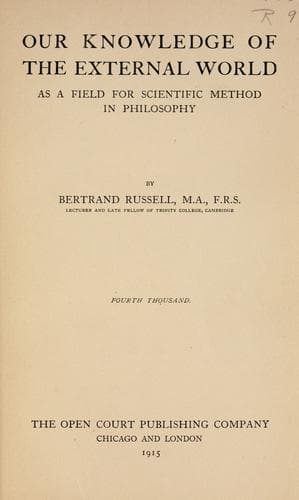
Our Knowledge of the External World as a Field for Scientific Method in PhilosophyRussell, Bertrand
Philosophy
Our Knowledge of the External World as a Field for Scientific Method in Philosophy
Russell, Bertrand
Knowledge, Theory of; Logical atomism
What we have said so far is that there have been hitherto certain
observed causal laws, and that all the empirical evidence we possess is
compatible with the view that everything, both mental and physical, so
far as our observation has extended, has happened in accordance with
causal laws. The law of universal causation, suggested by these facts,
may be enunciated as follows:
"There are such invariable relations between different events at the
same or different times that, given the state of the whole universe
throughout any finite time, however short, every previous and subsequent
event can theoretically be determined as a function of the given events
during that time."
Have we any reason to believe this universal law? Or, to ask a more
modest question, have we any reason to believe that a particular causal
law, such as the law of gravitation, will continue to hold in the
future?
Among observed causal laws is this, that observation of uniformities is
followed by expectation of their recurrence. A horse who has been driven
always along a certain road expects to be driven along that road again;
a dog who is always fed at a certain hour expects food at that hour and
not at any other. Such expectations, as Hume pointed out, explain only
too well the common-sense belief in uniformities of sequence, but they
afford absolutely no logical ground for beliefs as to the future, not
even for the belief that we shall continue to expect the continuation of
experienced uniformities, for that is precisely one of those causal laws
for which a ground has to be sought. If Hume's account of causation is
the last word, we have not only no reason to suppose that the sun will
rise to-morrow, but no reason to suppose that five minutes hence we
shall still expect it to rise to-morrow.
It may, of course, be said that all inferences as to the future are in
fact invalid, and I do not see how such a view could be disproved. But,
while admitting the legitimacy of such a view, we may nevertheless
inquire: If inferences as to the future _are_ valid, what principle must
be involved in making them?
Public-domain text, read in full here on John Shaqi.
Reviews
Reviews
No reviews yet
Be the first to share your thoughts on this work.
Elsewhere in the archive
Join the Discussion
Join the discussion
Sign in to leave a comment or review.
Sign InorCreate an account