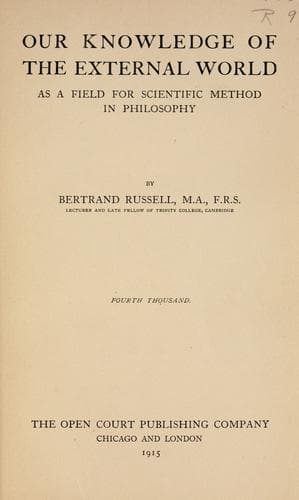
Our Knowledge of the External World as a Field for Scientific Method in PhilosophyRussell, Bertrand
Philosophy
Our Knowledge of the External World as a Field for Scientific Method in Philosophy
Russell, Bertrand
Knowledge, Theory of; Logical atomism
Evolutionism, if what has been said is true, is to be regarded as a
hasty generalisation from certain rather special facts, accompanied by a
dogmatic rejection of all attempts at analysis, and inspired by
interests which are practical rather than theoretical. In spite,
therefore, of its appeal to detailed results in various sciences, it
cannot be regarded as any more genuinely scientific than the classical
tradition which it has replaced. How philosophy is to be rendered
scientific, and what is the true subject-matter of philosophy, I shall
try to show first by examples of certain achieved results, and then more
generally. We will begin with the problem of the physical conceptions of
space and time and matter, which, as we have seen, are challenged by the
contentions of the evolutionists. That these conceptions stand in need
of reconstruction will be admitted, and is indeed increasingly urged by
physicists themselves. It will also be admitted that the reconstruction
must take more account of change and the universal flux than is done in
the older mechanics with its fundamental conception of an indestructible
matter. But I do not think the reconstruction required is on Bergsonian
lines, nor do I think that his rejection of logic can be anything but
harmful. I shall not, however, adopt the method of explicit controversy,
but rather the method of independent inquiry, starting from what, in a
pre-philosophic stage, appear to be facts, and keeping always as close
to these initial data as the requirements of consistency will permit.
Public-domain text, read in full here on John Shaqi.
Reviews
Reviews
No reviews yet
Be the first to share your thoughts on this work.
Join the Discussion
Join the discussion
Sign in to leave a comment or review.
Sign InorCreate an account