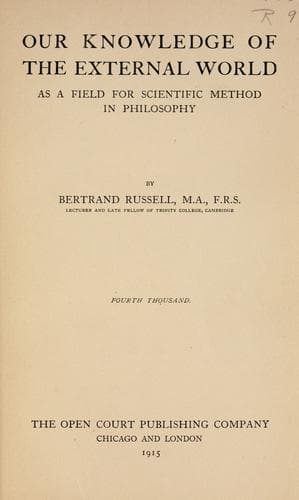
Our Knowledge of the External World as a Field for Scientific Method in PhilosophyRussell, Bertrand
Philosophy
Our Knowledge of the External World as a Field for Scientific Method in Philosophy
Russell, Bertrand
Knowledge, Theory of; Logical atomism
Although explicit controversy is almost always fruitless in philosophy,
owing to the fact that no two philosophers ever understand one another,
yet it seems necessary to say something at the outset in justification
of the scientific as against the mystical attitude. Metaphysics, from
the first, has been developed by the union or the conflict of these two
attitudes. Among the earliest Greek philosophers, the Ionians were more
scientific and the Sicilians more mystical.[6] But among the latter,
Pythagoras, for example, was in himself a curious mixture of the two
tendencies: the scientific attitude led him to his proposition on
right-angled triangles, while his mystic insight showed him that it is
wicked to eat beans. Naturally enough, his followers divided into two
sects, the lovers of right-angled triangles and the abhorrers of beans;
but the former sect died out, leaving, however, a haunting flavour of
mysticism over much Greek mathematical speculation, and in particular
over Plato's views on mathematics. Plato, of course, embodies both the
scientific and the mystical attitudes in a higher form than his
predecessors, but the mystical attitude is distinctly the stronger of
the two, and secures ultimate victory whenever the conflict is sharp.
Plato, moreover, adopted from the Eleatics the device of using logic to
defeat common sense, and thus to leave the field clear for mysticism--a
device still employed in our own day by the adherents of the classical
tradition.
[6] _Cf._ Burnet, _Early Greek Philosophy_, pp. 85 ff.
The logic used in defence of mysticism seems to me faulty as logic, and
in a later lecture I shall criticise it on this ground. But the more
thorough-going mystics do not employ logic, which they despise: they
appeal instead directly to the immediate deliverance of their insight.
Now, although fully developed mysticism is rare in the West, some
tincture of it colours the thoughts of many people, particularly as
regards matters on which they have strong convictions not based on
evidence. In all who seek passionately for the fugitive and difficult
goods, the conviction is almost irresistible that there is in the world
something deeper, more significant, than the multiplicity of little
facts chronicled and classified by science. Behind the veil of these
mundane things, they feel, something quite different obscurely shimmers,
shining forth clearly in the great moments of illumination, which alone
give anything worthy to be called real knowledge of truth. To seek such
moments, therefore, is to them the way of wisdom, rather than, like the
man of science, to observe coolly, to analyse without emotion, and to
accept without question the equal reality of the trivial and the
important.
Public-domain text, read in full here on John Shaqi.
Reviews
Reviews
No reviews yet
Be the first to share your thoughts on this work.
Join the Discussion
Join the discussion
Sign in to leave a comment or review.
Sign InorCreate an account