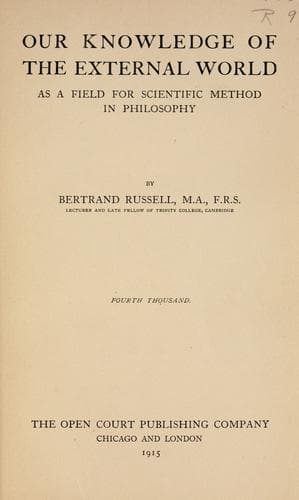
Our Knowledge of the External World as a Field for Scientific Method in PhilosophyRussell, Bertrand
Philosophy
Our Knowledge of the External World as a Field for Scientific Method in Philosophy
Russell, Bertrand
Knowledge, Theory of; Logical atomism
The principle involved is the principle of induction, which, if it is
true, must be an _a priori_ logical law, not capable of being proved or
disproved by experience. It is a difficult question how this principle
ought to be formulated; but if it is to warrant the inferences which we
wish to make by its means, it must lead to the following proposition:
"If, in a great number of instances, a thing of a certain kind is
associated in a certain way with a thing of a certain other kind, it is
probable that a thing of the one kind is always similarly associated
with a thing of the other kind; and as the number of instances
increases, the probability approaches indefinitely near to certainty."
It may well be questioned whether this proposition is true; but if we
admit it, we can infer that any characteristic of the whole of the
observed past is likely to apply to the future and to the unobserved
past. This proposition, therefore, if it is true, will warrant the
inference that causal laws probably hold at all times, future as well as
past; but without this principle, the observed cases of the truth of
causal laws afford no presumption as to the unobserved cases, and
therefore the existence of a thing not directly observed can never be
validly inferred.
It is thus the principle of induction, rather than the law of causality,
which is at the bottom of all inferences as to the existence of things
not immediately given. With the principle of induction, all that is
wanted for such inferences can be proved; without it, all such
inferences are invalid. This principle has not received the attention
which its great importance deserves. Those who were interested in
deductive logic naturally enough ignored it, while those who emphasised
the scope of induction wished to maintain that all logic is empirical,
and therefore could not be expected to realise that induction itself,
their own darling, required a logical principle which obviously could
not be proved inductively, and must therefore be _a priori_ if it could
be known at all.
The view that the law of causality itself is _a priori_ cannot, I think,
be maintained by anyone who realises what a complicated principle it is.
In the form which states that "every event has a cause" it looks simple;
but on examination, "cause" is merged in "causal law," and the
definition of a "causal law" is found to be far from simple. There must
necessarily be _some a priori_ principle involved in inference from
the existence of one thing to that of another, if such inference is ever
valid; but it would appear from the above analysis that the principle in
question is induction, not causality. Whether inferences from past to
future are valid depends wholly, if our discussion has been sound, upon
the inductive principle: if it is true, such inferences are valid, and
if it is false, they are invalid.
Public-domain text, read in full here on John Shaqi.
Reviews
Reviews
No reviews yet
Be the first to share your thoughts on this work.
Elsewhere in the archive
Join the Discussion
Join the discussion
Sign in to leave a comment or review.
Sign InorCreate an account