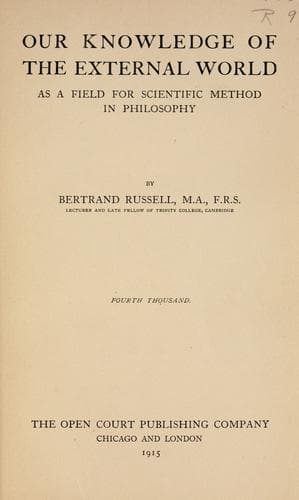
Our Knowledge of the External World as a Field for Scientific Method in PhilosophyRussell, Bertrand
Philosophy
Our Knowledge of the External World as a Field for Scientific Method in Philosophy
Russell, Bertrand
Knowledge, Theory of; Logical atomism
IV. I come now to the question how the conception of causal laws which
we have arrived at is related to the traditional conception of cause as
it occurs in philosophy and common sense.
Historically, the notion of cause has been bound up with that of human
volition. The typical cause would be the fiat of a king. The cause is
supposed to be "active," the effect "passive." From this it is easy to
pass on to the suggestion that a "true" cause must contain some
prevision of the effect; hence the effect becomes the "end" at which the
cause aims, and teleology replaces causation in the explanation of
nature. But all such ideas, as applied to physics, are mere
anthropomorphic superstitions. It is as a reaction against these errors
that Mach and others have urged a purely "descriptive" view of physics:
physics, they say, does not aim at telling us "why" things happen, but
only "how" they happen. And if the question "why?" means anything more
than the search for a general law according to which a phenomenon
occurs, then it is certainly the case that this question cannot be
answered in physics and ought not to be asked. In this sense, the
descriptive view is indubitably in the right. But in using causal laws
to support inferences from the observed to the unobserved, physics
ceases to be _purely_ descriptive, and it is these laws which give the
scientifically useful part of the traditional notion of "cause." There
is therefore _something_ to preserve in this notion, though it is a very
tiny part of what is commonly assumed in orthodox metaphysics.
In order to understand the difference between the kind of cause which
science uses and the kind which we naturally imagine, it is necessary to
shut out, by an effort, everything that differentiates between past and
future. This is an extraordinarily difficult thing to do, because our
mental life is so intimately bound up with difference. Not only do
memory and hope make a difference in our feelings as regards past and
future, but almost our whole vocabulary is filled with the idea of
activity, of things done now for the sake of their future effects. All
transitive verbs involve the notion of cause as activity, and would have
to be replaced by some cumbrous periphrasis before this notion could be
eliminated.
Public-domain text, read in full here on John Shaqi.
Reviews
Reviews
No reviews yet
Be the first to share your thoughts on this work.
Elsewhere in the archive
Join the Discussion
Join the discussion
Sign in to leave a comment or review.
Sign InorCreate an account