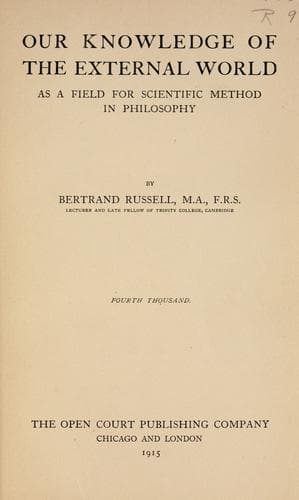
Our Knowledge of the External World as a Field for Scientific Method in PhilosophyRussell, Bertrand
Philosophy
Our Knowledge of the External World as a Field for Scientific Method in Philosophy
Russell, Bertrand
Knowledge, Theory of; Logical atomism
Consider such a statement as, "Brutus killed Cæsar." On another
occasion, Brutus and Cæsar might engage our attention, but for the
present it is the killing that we have to study. We may say that to kill
a person is to cause his death intentionally. This means that desire for
a person's death causes a certain act, because it is believed that that
act will cause the person's death; or more accurately, the desire and
the belief jointly cause the act. Brutus desires that Cæsar should be
dead, and believes that he will be dead if he is stabbed; Brutus
therefore stabs him, and the stab causes Cæsar's death, as Brutus
expected it would. Every act which realises a purpose involves two
causal steps in this way: C is desired, and it is believed (truly if the
purpose is achieved) that B will cause C; the desire and the belief
together cause B, which in turn causes C. Thus we have first A, which is
a desire for C and a belief that B (an act) will cause C; then we have
B, the act caused by A, and believed to be a cause of C; then, if the
belief was correct, we have C, caused by B, and if the belief was
incorrect we have disappointment. Regarded purely scientifically, this
series A, B, C may equally well be considered in the inverse order, as
they would be at a coroner's inquest. But from the point of view of
Brutus, the desire, which comes at the beginning, is what makes the
whole series interesting. We feel that if his desires had been
different, the effects which he in fact produced would not have
occurred. This is true, and gives him a sense of power and freedom. It
is equally true that if the effects had not occurred, his desires would
have been different, since being what they were the effects did occur.
Thus the desires are determined by their consequences just as much as
the consequences by the desires; but as we cannot (in general) know in
advance the consequences of our desires without knowing our desires,
this form of inference is uninteresting as applied to our own acts,
though quite vital as applied to those of others.
A cause, considered scientifically, has none of that analogy with
volition which makes us imagine that the effect is _compelled_ by it. A
cause is an event or group of events, of some known general character,
and having a known relation to some other event, called the effect; the
relation being of such a kind that only one event, or at any rate only
one well-defined sort of event, can have the relation to a given cause.
It is customary only to give the name "effect" to an event which is
later than the cause, but there is no kind of reason for this
restriction. We shall do better to allow the effect to be before the
cause or simultaneous with it, because nothing of any scientific
importance depends upon its being after the cause.
Public-domain text, read in full here on John Shaqi.
Reviews
Reviews
No reviews yet
Be the first to share your thoughts on this work.
Elsewhere in the archive
Join the Discussion
Join the discussion
Sign in to leave a comment or review.
Sign InorCreate an account