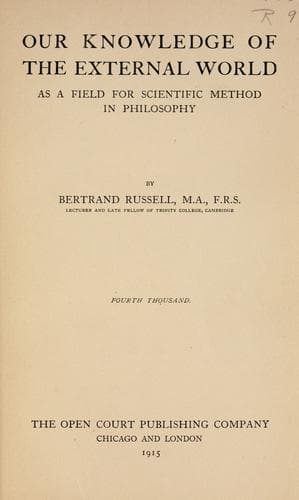
Our Knowledge of the External World as a Field for Scientific Method in PhilosophyRussell, Bertrand
Philosophy
Our Knowledge of the External World as a Field for Scientific Method in Philosophy
Russell, Bertrand
Knowledge, Theory of; Logical atomism
If the inference from cause to effect is to be indubitable, it seems
that the cause can hardly stop short of the whole universe. So long as
anything is left out, something may be left out which alters the
expected result. But for practical and scientific purposes, phenomena
can be collected into groups which are causally self-contained, or
nearly so. In the common notion of causation, the cause is a single
event--we say the lightning causes the thunder, and so on. But it is
difficult to know what we mean by a single event; and it generally
appears that, in order to have anything approaching certainty concerning
the effect, it is necessary to include many more circumstances in the
cause than unscientific common sense would suppose. But often a probable
causal connection, where the cause is fairly simple, is of more
practical importance than a more indubitable connection in which the
cause is so complex as to be hard to ascertain.
To sum up: the strict, certain, universal law of causation which
philosophers advocate is an ideal, possibly true, but not _known_ to be
true in virtue of any available evidence. What is actually known, as a
matter of empirical science, is that certain constant relations are
observed to hold between the members of a group of events at certain
times, and that when such relations fail, as they sometimes do, it is
usually possible to discover a new, more constant relation by enlarging
the group. Any such constant relation between events of specified kinds
with given intervals of time between them is a "causal law." But all
causal laws are liable to exceptions, if the cause is less than the
whole state of the universe; we believe, on the basis of a good deal of
experience, that such exceptions can be dealt with by enlarging the
group we call the cause, but this belief, wherever it is still
unverified, ought not to be regarded as certain, but only as suggesting
a direction for further inquiry.
A very common causal group consists of volitions and the consequent
bodily acts, though exceptions arise (for example) through sudden
paralysis. Another very frequent connection (though here the exceptions
are much more numerous) is between a bodily act and the realisation of
the purpose which led to the act. These connections are patent, whereas
the causes of desires are more obscure. Thus it is natural to begin
causal series with desires, to suppose that all causes are analogous to
desires, and that desires themselves arise spontaneously. Such a view,
however, is not one which any serious psychologist would maintain. But
this brings us to the question of the application of our analysis of
cause to the problem of free will.
Public-domain text, read in full here on John Shaqi.
Reviews
Reviews
No reviews yet
Be the first to share your thoughts on this work.
Elsewhere in the archive
Join the Discussion
Join the discussion
Sign in to leave a comment or review.
Sign InorCreate an account