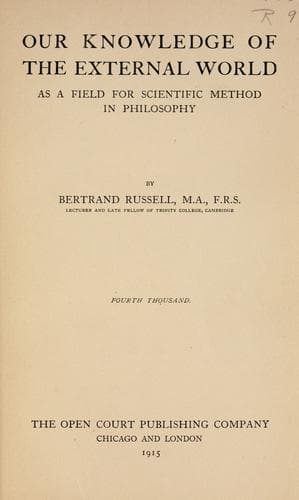
Our Knowledge of the External World as a Field for Scientific Method in PhilosophyRussell, Bertrand
Philosophy
Our Knowledge of the External World as a Field for Scientific Method in Philosophy
Russell, Bertrand
Knowledge, Theory of; Logical atomism
V. The problem of free will is so intimately bound up with the analysis
of causation that, old as it is, we need not despair of obtaining new
light on it by the help of new views on the notion of cause. The
free-will problem has, at one time or another, stirred men's passions
profoundly, and the fear that the will might not be free has been to
some men a source of great unhappiness. I believe that, under the
influence of a cool analysis, the doubtful questions involved will be
found to have no such emotional importance as is sometimes thought,
since the disagreeable consequences supposed to flow from a denial of
free will do not flow from this denial in any form in which there is
reason to make it. It is not, however, on this account chiefly that I
wish to discuss this problem, but rather because it affords a good
example of the clarifying effect of analysis and of the interminable
controversies which may result from its neglect.
Let us first try to discover what it is we really desire when we desire
free will. Some of our reasons for desiring free will are profound, some
trivial. To begin with the former: we do not wish to feel ourselves in
the hands of fate, so that, however much we may desire to will one
thing, we may nevertheless be compelled by an outside force to will
another. We do not wish to think that, however much we may desire to act
well, heredity and surroundings may force us into acting ill. We wish to
feel that, in cases of doubt, our choice is momentous and lies within
our power. Besides these desires, which are worthy of all respect, we
have, however, others not so respectable, which equally make us desire
free will. We do not like to think that other people, if they knew
enough, could predict our actions, though we know that we can often
predict those of other people, especially if they are elderly. Much as
we esteem the old gentleman who is our neighbour in the country, we know
that when grouse are mentioned he will tell the story of the grouse in
the gun-room. But we ourselves are not so mechanical: we never tell an
anecdote to the same person twice, or even once unless he is sure to
enjoy it; although we once met (say) Bismarck, we are quite capable of
hearing him mentioned without relating the occasion when we met him. In
this sense, everybody thinks that he himself has free will, though he
knows that no one else has. The desire for this kind of free will seems
to be no better than a form of vanity. I do not believe that this desire
can be gratified with any certainty; but the other, more respectable
desires are, I believe, not inconsistent with any tenable form of
determinism.
Public-domain text, read in full here on John Shaqi.
Reviews
Reviews
No reviews yet
Be the first to share your thoughts on this work.
Elsewhere in the archive
Join the Discussion
Join the discussion
Sign in to leave a comment or review.
Sign InorCreate an account