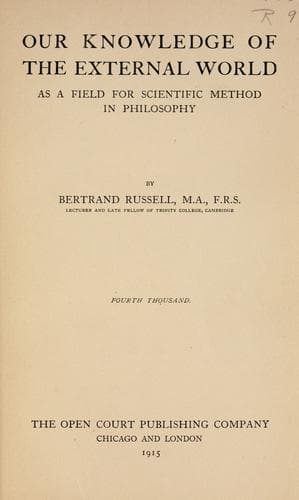
Our Knowledge of the External World as a Field for Scientific Method in PhilosophyRussell, Bertrand
Philosophy
Our Knowledge of the External World as a Field for Scientific Method in Philosophy
Russell, Bertrand
Knowledge, Theory of; Logical atomism
We have thus two questions to consider: (1) Are human actions
theoretically predictable from a sufficient number of antecedents? (2)
Are human actions subject to an external compulsion? The two questions,
as I shall try to show, are entirely distinct, and we may answer the
first in the affirmative without therefore being forced to give an
affirmative answer to the second.
(1) _Are human actions theoretically predictable from a sufficient
number of antecedents?_ Let us first endeavour to give precision to this
question. We may state the question thus: Is there some constant
relation between an act and a certain number of earlier events, such
that, when the earlier events are given, only one act, or at most only
acts with some well-marked character, can have this relation to the
earlier events? If this is the case, then, as soon as the earlier events
are known, it is theoretically possible to predict either the precise
act, or at least the character necessary to its fulfilling the constant
relation.
To this question, a negative answer has been given by Bergson, in a form
which calls in question the general applicability of the law of
causation. He maintains that every event, and more particularly every
mental event, embodies so much of the past that it could not possibly
have occurred at any earlier time, and is therefore necessarily quite
different from all previous and subsequent events. If, for example, I
read a certain poem many times, my experience on each occasion is
modified by the previous readings, and my emotions are never repeated
exactly. The principle of causation, according to him, asserts that the
same cause, if repeated, will produce the same effect. But owing to
memory, he contends, this principle does not apply to mental events.
What is apparently the same cause, if repeated, is modified by the mere
fact of repetition, and cannot produce the same effect. He infers that
every mental event is a genuine novelty, not predictable from the past,
because the past contains nothing exactly like it by which we could
imagine it. And on this ground he regards the freedom of the will as
unassailable.
Public-domain text, read in full here on John Shaqi.
Reviews
Reviews
No reviews yet
Be the first to share your thoughts on this work.
Elsewhere in the archive
Join the Discussion
Join the discussion
Sign in to leave a comment or review.
Sign InorCreate an account