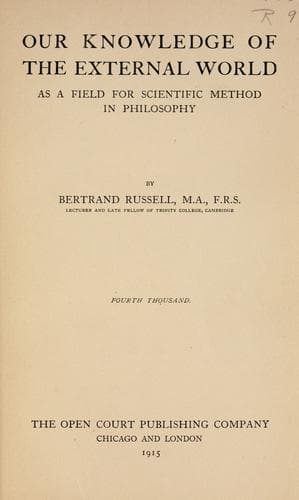
Our Knowledge of the External World as a Field for Scientific Method in PhilosophyRussell, Bertrand
Philosophy
Our Knowledge of the External World as a Field for Scientific Method in Philosophy
Russell, Bertrand
Knowledge, Theory of; Logical atomism
Bergson's contention has undoubtedly a great deal of truth, and I have
no wish to deny its importance. But I do not think its consequences are
quite what he believes them to be. It is not necessary for the
determinist to maintain that he can foresee the whole particularity of
the act which will be performed. If he could foresee that A was going to
murder B, his foresight would not be invalidated by the fact that he
could not know all the infinite complexity of A's state of mind in
committing the murder, nor whether the murder was to be performed with a
knife or with a revolver. If the _kind_ of act which will be performed
can be foreseen within narrow limits, it is of little practical interest
that there are fine shades which cannot be foreseen. No doubt every time
the story of the grouse in the gun-room is told, there will be slight
differences due to increasing habitualness, but they do not invalidate
the prediction that the story will be told. And there is nothing in
Bergson's argument to show that we can never predict what _kind_ of act
will be performed.
Again, his statement of the law of causation is inadequate. The law does
not state merely that, if the _same_ cause is repeated, the _same_
effect will result. It states rather that there is a constant relation
between causes of certain kinds and effects of certain kinds. For
example, if a body falls freely, there is a constant relation between
the height through which it falls and the time it takes in falling. It
is not necessary to have a body fall through the _same_ height which has
been previously observed, in order to be able to foretell the length of
time occupied in falling. If this were necessary, no prediction would be
possible, since it would be impossible to make the height exactly the
same on two occasions. Similarly, the attraction which the sun will
exert on the earth is not only known at distances for which it has been
observed, but at all distances, because it is known to vary as the
inverse square of the distance. In fact, what is found to be repeated is
always the _relation_ of cause and effect, not the cause itself; all
that is necessary as regards the cause is that it should be of the same
_kind_ (in the relevant respect) as earlier causes whose effects have
been observed.
Public-domain text, read in full here on John Shaqi.
Reviews
Reviews
No reviews yet
Be the first to share your thoughts on this work.
Elsewhere in the archive