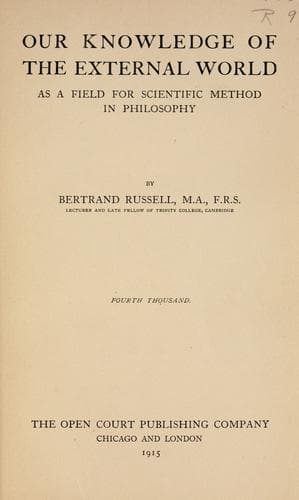
Our Knowledge of the External World as a Field for Scientific Method in PhilosophyRussell, Bertrand
Philosophy
Our Knowledge of the External World as a Field for Scientific Method in Philosophy
Russell, Bertrand
Knowledge, Theory of; Logical atomism
Another respect in which Bergson's statement of causation is inadequate
is in its assumption that the cause must be _one_ event, whereas it may
be two or more events, or even some continuous process. The substantive
question at issue is whether mental events are determined by the past.
Now in such a case as the repeated reading of a poem, it is obvious that
our feelings in reading the poem are most emphatically dependent upon
the past, but not upon one single event in the past. All our previous
readings of the poem must be included in the cause. But we easily
perceive a certain law according to which the effect varies as the
previous readings increase in number, and in fact Bergson himself
tacitly assumes such a law. We decide at last not to read the poem
again, because we know that this time the effect would be boredom. We
may not know all the niceties and shades of the boredom we should feel,
but we know enough to guide our decision, and the prophecy of boredom is
none the less true for being more or less general. Thus the kinds of
cases upon which Bergson relies are insufficient to show the
impossibility of prediction in the only sense in which prediction has
practical or emotional interest. We may therefore leave the
consideration of his arguments and address ourselves to the problem
directly.
The law of causation, according to which later events can theoretically
be predicted by means of earlier events, has often been held to be _a
priori_, a necessity of thought, a category without which science would
be impossible. These claims seem to me excessive. In certain directions
the law has been verified empirically, and in other directions there is
no positive evidence against it. But science can use it where it has
been found to be true, without being forced into any assumption as to
its truth in other fields. We cannot, therefore, feel any _a priori_
certainty that causation must apply to human volitions.
The question how far human volitions are subject to causal laws is a
purely empirical one. Empirically it seems plain that the great majority
of our volitions have causes, but it cannot, on this account, be held
necessarily certain that all have causes. There are, however, precisely
the same kinds of reasons for regarding it as probable that they all
have causes as there are in the case of physical events.
Public-domain text, read in full here on John Shaqi.
Reviews
Reviews
No reviews yet
Be the first to share your thoughts on this work.
Elsewhere in the archive
Join the Discussion
Join the discussion
Sign in to leave a comment or review.
Sign InorCreate an account