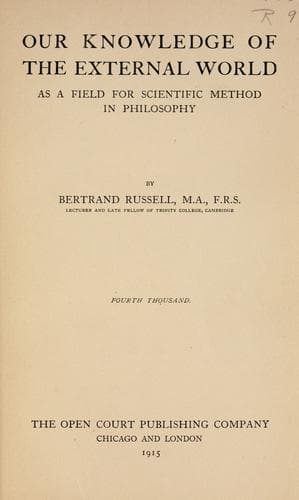
Our Knowledge of the External World as a Field for Scientific Method in PhilosophyRussell, Bertrand
Philosophy
Our Knowledge of the External World as a Field for Scientific Method in Philosophy
Russell, Bertrand
Knowledge, Theory of; Logical atomism
We may suppose--though this is doubtful--that there are laws of
correlation of the mental and the physical, in virtue of which, given
the state of all the matter in the world, and therefore of all the
brains and living organisms, the state of all the minds in the world
could be inferred, while conversely the state of all the matter in the
world could be inferred if the state of all the minds were given. It is
obvious that there is _some_ degree of correlation between brain and
mind, and it is impossible to say how complete it may be. This, however,
is not the point which I wish to elicit. What I wish to urge is that,
even if we admit the most extreme claims of determinism and of
correlation of mind and brain, still the consequences inimical to what
is worth preserving in free will do not follow. The belief that they
follow results, I think, entirely from the assimilation of causes to
volitions, and from the notion that causes _compel_ their effects in
some sense analogous to that in which a human authority can compel a man
to do what he would rather not do. This assimilation, as soon as the
true nature of scientific causal laws is realised, is seen to be a sheer
mistake. But this brings us to the second of the two questions which we
raised in regard to free will, namely, whether, assuming determinism,
our actions can be in any proper sense regarded as compelled by outside
forces.
(2) _Are human actions subject to an external compulsion?_ We have, in
deliberation, a subjective sense of freedom, which is sometimes alleged
against the view that volitions have causes. This sense of freedom,
however, is only a sense that we can choose which we please of a number
of alternatives: it does not show us that there is no causal connection
between what we please to choose and our previous history. The supposed
inconsistency of these two springs from the habit of conceiving causes
as analogous to volitions--a habit which often survives unconsciously in
those who intend to conceive causes in a more scientific manner. If a
cause is analogous to a volition, outside causes will be analogous to an
alien will, and acts predictable from outside causes will be subject to
compulsion. But this view of cause is one to which science lends no
countenance. Causes, we have seen, do not _compel_ their effects, any
more than effects _compel_ their causes. There is a mutual relation, so
that either can be inferred from the other. When the geologist infers
the past state of the earth from its present state, we should not say
that the present state _compels_ the past state to have been what it
was; yet it renders it necessary as a consequence of the data, in the
only sense in which effects are rendered necessary by their causes. The
difference which we _feel_, in this respect, between causes and effects
is a mere confusion due to the fact that we remember past events but do
not happen to have memory of the future.
Public-domain text, read in full here on John Shaqi.
Reviews
Reviews
No reviews yet
Be the first to share your thoughts on this work.
Elsewhere in the archive
Join the Discussion
Join the discussion
Sign in to leave a comment or review.
Sign InorCreate an account