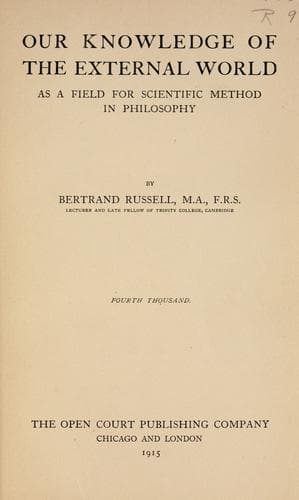
Our Knowledge of the External World as a Field for Scientific Method in PhilosophyRussell, Bertrand
Philosophy
Our Knowledge of the External World as a Field for Scientific Method in Philosophy
Russell, Bertrand
Knowledge, Theory of; Logical atomism
Where instinct and reason do sometimes conflict is in regard to single
beliefs, held instinctively, and held with such determination that no
degree of inconsistency with other beliefs leads to their abandonment.
Instinct, like all human faculties, is liable to error. Those in whom
reason is weak are often unwilling to admit this as regards themselves,
though all admit it in regard to others. Where instinct is least liable
to error is in practical matters as to which right judgment is a help to
survival; friendship and hostility in others, for instance, are often
felt with extraordinary discrimination through very careful disguises.
But even in such matters a wrong impression may be given by reserve or
flattery; and in matters less directly practical, such as philosophy
deals with, very strong instinctive beliefs may be wholly mistaken, as
we may come to know through their perceived inconsistency with other
equally strong beliefs. It is such considerations that necessitate the
harmonising mediation of reason, which tests our beliefs by their mutual
compatibility, and examines, in doubtful cases, the possible sources of
error on the one side and on the other. In this there is no opposition
to instinct as a whole, but only to blind reliance upon some one
interesting aspect of instinct to the exclusion of other more
commonplace but not less trustworthy aspects. It is such onesidedness,
not instinct itself, that reason aims at correcting.
These more or less trite maxims may be illustrated by application to
Bergson's advocacy of "intuition" as against "intellect." There are, he
says, "two profoundly different ways of knowing a thing. The first
implies that we move round the object; the second that we enter into it.
The first depends on the point of view at which we are placed and on the
symbols by which we express ourselves. The second neither depends on a
point of view nor relies on any symbol. The first kind of knowledge may
be said to stop at the _relative_; the second, in those cases where it
is possible, to attain the _absolute_."[7] The second of these, which is
intuition, is, he says, "the kind of intellectual _sympathy_ by which
one places oneself within an object in order to coincide with what is
unique in it and therefore inexpressible" (p. 6). In illustration, he
mentions self-knowledge: "there is one reality, at least, which we all
seize from within, by intuition and not by simple analysis. It is our
own personality in its flowing through time--our self which endures"
(p. 8). The rest of Bergson's philosophy consists in reporting, through
the imperfect medium of words, the knowledge gained by intuition, and
the consequent complete condemnation of all the pretended knowledge
derived from science and common sense.
[7] _Introduction to Metaphysics_, p. 1.
Public-domain text, read in full here on John Shaqi.
Reviews
Reviews
No reviews yet
Be the first to share your thoughts on this work.
Join the Discussion
Join the discussion
Sign in to leave a comment or review.
Sign InorCreate an account