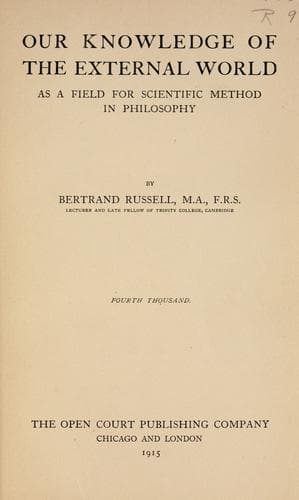
Our Knowledge of the External World as a Field for Scientific Method in PhilosophyRussell, Bertrand
Philosophy
Our Knowledge of the External World as a Field for Scientific Method in Philosophy
Russell, Bertrand
Knowledge, Theory of; Logical atomism
This procedure, since it takes sides in a conflict of instinctive
beliefs, stands in need of justification by proving the greater
trustworthiness of the beliefs on one side than of those on the other.
Bergson attempts this justification in two ways--first, by explaining
that intellect is a purely practical faculty designed to secure
biological success; secondly, by mentioning remarkable feats of instinct
in animals, and by pointing out characteristics of the world which,
though intuition can apprehend them, are baffling to intellect as he
interprets it.
Of Bergson's theory that intellect is a purely practical faculty
developed in the struggle for survival, and not a source of true
beliefs, we may say, first, that it is only through intellect that we
know of the struggle for survival and of the biological ancestry of man:
if the intellect is misleading, the whole of this merely inferred
history is presumably untrue. If, on the other hand, we agree with M.
Bergson in thinking that evolution took place as Darwin believed, then
it is not only intellect, but all our faculties, that have been
developed under the stress of practical utility. Intuition is seen at
its best where it is directly useful--for example, in regard to other
people's characters and dispositions. Bergson apparently holds that
capacity for this kind of knowledge is less explicable by the struggle
for existence than, for example, capacity for pure mathematics. Yet the
savage deceived by false friendship is likely to pay for his mistake
with his life; whereas even in the most civilised societies men are not
put to death for mathematical incompetence. All the most striking of his
instances of intuition in animals have a very direct survival value. The
fact is, of course, that both intuition and intellect have been
developed because they are useful, and that, speaking broadly, they are
useful when they give truth and become harmful when they give falsehood.
Intellect, in civilised man, like artistic capacity, has occasionally
been developed beyond the point where it is useful to the individual;
intuition, on the other hand, seems on the whole to diminish as
civilisation increases. Speaking broadly, it is greater in children than
in adults, in the uneducated than in the educated. Probably in dogs it
exceeds anything to be found in human beings. But those who find in
these facts a recommendation of intuition ought to return to running
wild in the woods, dyeing themselves with woad and living on hips and
haws.
Public-domain text, read in full here on John Shaqi.
Reviews
Reviews
No reviews yet
Be the first to share your thoughts on this work.
Join the Discussion
Join the discussion
Sign in to leave a comment or review.
Sign InorCreate an account