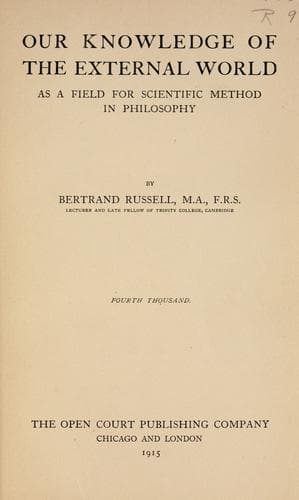
Our Knowledge of the External World as a Field for Scientific Method in PhilosophyRussell, Bertrand
Philosophy
Our Knowledge of the External World as a Field for Scientific Method in Philosophy
Russell, Bertrand
Knowledge, Theory of; Logical atomism
Let us next examine whether intuition possesses any such infallibility
as Bergson claims for it. The best instance of it, according to him, is
our acquaintance with ourselves; yet self-knowledge is proverbially rare
and difficult. Most men, for example, have in their nature meannesses,
vanities, and envies of which they are quite unconscious, though even
their best friends can perceive them without any difficulty. It is true
that intuition has a convincingness which is lacking to intellect: while
it is present, it is almost impossible to doubt its truth. But if it
should appear, on examination, to be at least as fallible as intellect,
its greater subjective certainty becomes a demerit, making it only the
more irresistibly deceptive. Apart from self-knowledge, one of the most
notable examples of intuition is the knowledge people believe themselves
to possess of those with whom they are in love: the wall between
different personalities seems to become transparent, and people think
they see into another soul as into their own. Yet deception in such
cases is constantly practised with success; and even where there is no
intentional deception, experience gradually proves, as a rule, that the
supposed insight was illusory, and that the slower, more groping methods
of the intellect are in the long run more reliable.
Bergson maintains that intellect can only deal with things in so far as
they resemble what has been experienced in the past, while intuition has
the power of apprehending the uniqueness and novelty that always belong
to each fresh moment. That there is something unique and new at every
moment, is certainly true; it is also true that this cannot be fully
expressed by means of intellectual concepts. Only direct acquaintance
can give knowledge of what is unique and new. But direct acquaintance of
this kind is given fully in sensation, and does not require, so far as I
can see, any special faculty of intuition for its apprehension. It is
neither intellect nor intuition, but sensation, that supplies new data;
but when the data are new in any remarkable manner, intellect is much
more capable of dealing with them than intuition would be. The hen with
a brood of ducklings no doubt has intuitions which seem to place her
inside them, and not merely to know them analytically; but when the
ducklings take to the water, the whole apparent intuition is seen to be
illusory, and the hen is left helpless on the shore. Intuition, in fact,
is an aspect and development of instinct, and, like all instinct, is
admirable in those customary surroundings which have moulded the habits
of the animal in question, but totally incompetent as soon as the
surroundings are changed in a way which demands some non-habitual mode
of action.
Public-domain text, read in full here on John Shaqi.
Reviews
Reviews
No reviews yet
Be the first to share your thoughts on this work.
Join the Discussion
Join the discussion
Sign in to leave a comment or review.
Sign InorCreate an account