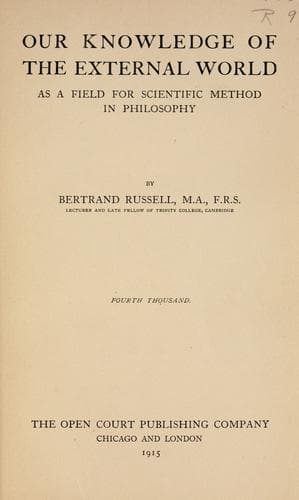
Our Knowledge of the External World as a Field for Scientific Method in PhilosophyRussell, Bertrand
Philosophy
Our Knowledge of the External World as a Field for Scientific Method in Philosophy
Russell, Bertrand
Knowledge, Theory of; Logical atomism
The immense extension of our knowledge of facts in recent times has had,
as it had in the Renaissance, two effects upon the general intellectual
outlook. On the one hand, it has made men distrustful of the truth of
wide, ambitious systems: theories come and go swiftly, each serving, for
a moment, to classify known facts and promote the search for new ones,
but each in turn proving inadequate to deal with the new facts when they
have been found. Even those who invent the theories do not, in science,
regard them as anything but a temporary makeshift. The ideal of an
all-embracing synthesis, such as the Middle Ages believed themselves to
have attained, recedes further and further beyond the limits of what
seems feasible. In such a world, as in the world of Montaigne, nothing
seems worth while except the discovery of more and more facts, each in
turn the deathblow to some cherished theory; the ordering intellect
grows weary, and becomes slovenly through despair.
On the other hand, the new facts have brought new powers; man's physical
control over natural forces has been increasing with unexampled
rapidity, and promises to increase in the future beyond all easily
assignable limits. Thus alongside of despair as regards ultimate theory
there is an immense optimism as regards practice: what man can _do_
seems almost boundless. The old fixed limits of human power, such as
death, or the dependence of the race on an equilibrium of cosmic forces,
are forgotten, and no hard facts are allowed to break in upon the dream
of omnipotence. No philosophy is tolerated which sets bounds to man's
capacity of gratifying his wishes; and thus the very despair of theory
is invoked to silence every whisper of doubt as regards the
possibilities of practical achievement.
In the welcoming of new fact, and in the suspicion of dogmatism as
regards the universe at large, the modern spirit should, I think, be
accepted as wholly an advance. But both in its practical pretensions and
in its theoretical despair it seems to me to go too far. Most of what is
greatest in man is called forth in response to the thwarting of his
hopes by immutable natural obstacles; by the pretence of omnipotence, he
becomes trivial and a little absurd. And on the theoretical side,
ultimate metaphysical truth, though less all-embracing and harder of
attainment than it appeared to some philosophers in the past, can, I
believe, be discovered by those who are willing to combine the
hopefulness, patience, and open-mindedness of science with something of
the Greek feeling for beauty in the abstract world of logic and for the
ultimate intrinsic value in the contemplation of truth.
Public-domain text, read in full here on John Shaqi.
Reviews
Reviews
No reviews yet
Be the first to share your thoughts on this work.
Join the Discussion
Join the discussion
Sign in to leave a comment or review.
Sign InorCreate an account