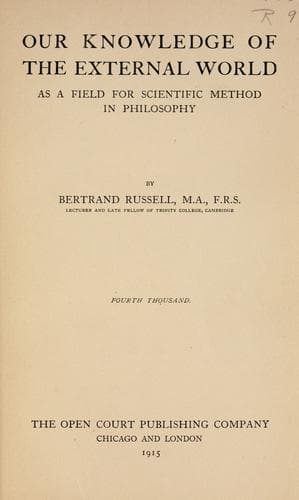
Our Knowledge of the External World as a Field for Scientific Method in PhilosophyRussell, Bertrand
Philosophy
Our Knowledge of the External World as a Field for Scientific Method in Philosophy
Russell, Bertrand
Knowledge, Theory of; Logical atomism
The philosophy, therefore, which is to be genuinely inspired by the
scientific spirit, must deal with somewhat dry and abstract matters, and
must not hope to find an answer to the practical problems of life. To
those who wish to understand much of what has in the past been most
difficult and obscure in the constitution of the universe, it has great
rewards to offer--triumphs as noteworthy as those of Newton and Darwin,
and as important in the long run, for the moulding of our mental habits.
And it brings with it--as a new and powerful method of investigation
always does--a sense of power and a hope of progress more reliable and
better grounded than any that rests on hasty and fallacious
generalisation as to the nature of the universe at large. Many hopes
which inspired philosophers in the past it cannot claim to fulfil; but
other hopes, more purely intellectual, it can satisfy more fully than
former ages could have deemed possible for human minds.
LECTURE II
LOGIC AS THE ESSENCE OF PHILOSOPHY
The topics we discussed in our first lecture, and the topics we shall
discuss later, all reduce themselves, in so far as they are genuinely
philosophical, to problems of logic. This is not due to any accident,
but to the fact that every philosophical problem, when it is subjected
to the necessary analysis and purification, is found either to be not
really philosophical at all, or else to be, in the sense in which we are
using the word, logical. But as the word "logic" is never used in the
same sense by two different philosophers, some explanation of what I
mean by the word is indispensable at the outset.
Logic, in the Middle Ages, and down to the present day in teaching,
meant no more than a scholastic collection of technical terms and rules
of syllogistic inference. Aristotle had spoken, and it was the part of
humbler men merely to repeat the lesson after him. The trivial nonsense
embodied in this tradition is still set in examinations, and defended by
eminent authorities as an excellent "propædeutic," _i.e._ a training in
those habits of solemn humbug which are so great a help in later life.
But it is not this that I mean to praise in saying that all philosophy
is logic. Ever since the beginning of the seventeenth century, all
vigorous minds that have concerned themselves with inference have
abandoned the mediæval tradition, and in one way or other have widened
the scope of logic.
Public-domain text, read in full here on John Shaqi.
Reviews
Reviews
No reviews yet
Be the first to share your thoughts on this work.
Join the Discussion
Join the discussion
Sign in to leave a comment or review.
Sign InorCreate an account