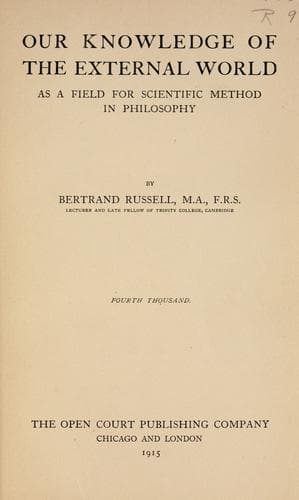
Our Knowledge of the External World as a Field for Scientific Method in PhilosophyRussell, Bertrand
Philosophy
Our Knowledge of the External World as a Field for Scientific Method in Philosophy
Russell, Bertrand
Knowledge, Theory of; Logical atomism
A method of proof which, when used as directed, gives sometimes truth
and sometimes falsehood--as the method of simple enumeration does--is
obviously not a valid method, for validity demands invariable truth.
Thus, if simple enumeration is to be rendered valid, it must not be
stated as Mill states it. We shall have to say, at most, that the data
render the result _probable_. Causation holds, we shall say, in every
instance we have been able to test; therefore it _probably_ holds in
untested instances. There are terrible difficulties in the notion of
probability, but we may ignore them at present. We thus have what at
least _may_ be a logical principle, since it is without exception. If a
proposition is true in every instance that we happen to know of, and if
the instances are very numerous, then, we shall say, it becomes very
probable, on the data, that it will be true in any further instance.
This is not refuted by the fact that what we declare to be probable does
not always happen, for an event may be probable on the data and yet not
occur. It is, however, obviously capable of further analysis, and of
more exact statement. We shall have to say something like this: that
every instance of a proposition[10] being true increases the probability
of its being true in a fresh instance, and that a sufficient number of
favourable instances will, in the absence of instances to the contrary,
make the probability of the truth of a fresh instance approach
indefinitely near to certainty. Some such principle as this is required
if the method of simple enumeration is to be valid.
[10] Or rather a propositional function.
But this brings us to our other question, namely, how is our principle
known to be true? Obviously, since it is required to justify induction,
it cannot be proved by induction; since it goes beyond the empirical
data, it cannot be proved by them alone; since it is required to justify
all inferences from empirical data to what goes beyond them, it cannot
itself be even rendered in any degree probable by such data. Hence, _if_
it is known, it is not known by experience, but independently of
experience. I do not say that any such principle is known: I only say
that it is required to justify the inferences from experience which
empiricists allow, and that it cannot itself be justified
empirically.[11]
[11] The subject of causality and induction will be discussed again in
Lecture VIII.
A similar conclusion can be proved by similar arguments concerning any
other logical principle. Thus logical knowledge is not derivable from
experience alone, and the empiricist's philosophy can therefore not be
accepted in its entirety, in spite of its excellence in many matters
which lie outside logic.
Public-domain text, read in full here on John Shaqi.
Reviews
Reviews
No reviews yet
Be the first to share your thoughts on this work.
Join the Discussion
Join the discussion
Sign in to leave a comment or review.
Sign InorCreate an account