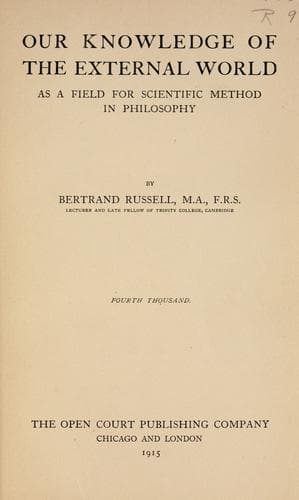
Our Knowledge of the External World as a Field for Scientific Method in Philosophy — John Shaqi
Our Knowledge of the External World as a Field for Scientific Method in PhilosophyRussell, Bertrand
Philosophy
Our Knowledge of the External World as a Field for Scientific Method in Philosophy
Russell, Bertrand
Knowledge, Theory of; Logical atomism
But if so, how are empirical generalisations to be justified? The
evidence in their favour cannot be empirical, since we wish to argue
from what has been observed to what has not been observed, which can
only be done by means of some known relation of the observed and the
unobserved; but the unobserved, by definition, is not known empirically,
and therefore its relation to the observed, if known at all, must be
known independently of empirical evidence. Let us see what Mill says on
this subject.
According to Mill, the law of causation is proved by an admittedly
fallible process called "induction by simple enumeration." This process,
he says, "consists in ascribing the nature of general truths to all
propositions which are true in every instance that we happen to know
of."[8] As regards its fallibility, he asserts that "the precariousness
of the method of simple enumeration is in an inverse ratio to the
largeness of the generalisation. The process is delusive and
insufficient, exactly in proportion as the subject-matter of the
observation is special and limited in extent. As the sphere widens, this
unscientific method becomes less and less liable to mislead; and the
most universal class of truths, the law of causation for instance, and
the principles of number and of geometry, are duly and satisfactorily
proved by that method alone, nor are they susceptible of any other
proof."[9]
[8] _Logic_, book iii., chapter iii., § 2.
[9] Book iii., chapter xxi., § 3.
In the above statement, there are two obvious lacunæ: (1) How is the
method of simple enumeration itself justified? (2) What logical
principle, if any, covers the same ground as this method, without being
liable to its failures? Let us take the second question first.
Public-domain text, read in full here on John Shaqi.
Reviews
Reviews
No reviews yet
Be the first to share your thoughts on this work.
Join the Discussion
Join the discussion
Sign in to leave a comment or review.
Sign InorCreate an account