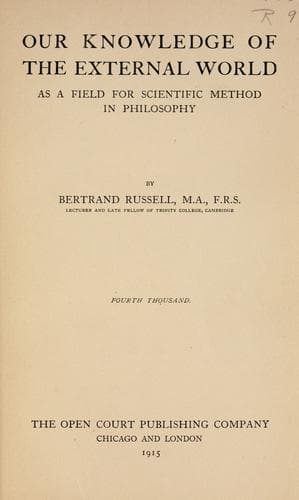
Our Knowledge of the External World as a Field for Scientific Method in PhilosophyRussell, Bertrand
Philosophy
Our Knowledge of the External World as a Field for Scientific Method in Philosophy
Russell, Bertrand
Knowledge, Theory of; Logical atomism
The way in which, as it seems to me, Hegel's system assumes the ordinary
logic which it subsequently criticises, is exemplified by the general
conception of "categories" with which he operates throughout. This
conception is, I think, essentially a product of logical confusion, but
it seems in some way to stand for the conception of "qualities of
Reality as a whole." Mr Bradley has worked out a theory according to
which, in all judgment, we are ascribing a predicate to Reality as a
whole; and this theory is derived from Hegel. Now the traditional logic
holds that every proposition ascribes a predicate to a subject, and from
this it easily follows that there can be only one subject, the Absolute,
for if there were two, the proposition that there were two would not
ascribe a predicate to either. Thus Hegel's doctrine, that philosophical
propositions must be of the form, "the Absolute is such-and-such,"
depends upon the traditional belief in the universality of the
subject-predicate form. This belief, being traditional, scarcely
self-conscious, and not supposed to be important, operates underground,
and is assumed in arguments which, like the refutation of relations,
appear at first sight such as to establish its truth. This is the most
important respect in which Hegel uncritically assumes the traditional
logic. Other less important respects--though important enough to be the
source of such essentially Hegelian conceptions as the "concrete
universal" and the "union of identity in difference"--will be found
where he explicitly deals with formal logic.[12]
[12] See the translation by H. S. Macran, _Hegel's Doctrine of Formal
Logic_, Oxford, 1912. Hegel's argument in this portion of his "Logic"
depends throughout upon confusing the "is" of predication, as in
"Socrates is mortal," with the "is" of identity, as in "Socrates is
the philosopher who drank the hemlock." Owing to this confusion, he
thinks that "Socrates" and "mortal" must be identical. Seeing that
they are different, he does not infer, as others would, that there is
a mistake somewhere, but that they exhibit "identity in difference."
Again, Socrates is particular, "mortal" is universal. Therefore, he
says, since Socrates is mortal, it follows that the particular is the
universal--taking the "is" to be throughout expressive of identity.
But to say "the particular is the universal" is self-contradictory.
Again Hegel does not suspect a mistake but proceeds to synthesise
particular and universal in the individual, or concrete universal.
This is an example of how, for want of care at the start, vast and
imposing systems of philosophy are built upon stupid and trivial
confusions, which, but for the almost incredible fact that they are
unintentional, one would be tempted to characterise as puns.
Public-domain text, read in full here on John Shaqi.
Reviews
Reviews
No reviews yet
Be the first to share your thoughts on this work.
Join the Discussion
Join the discussion
Sign in to leave a comment or review.
Sign InorCreate an account