Our Knowledge of the External World as a Field for Scientific Method in Philosophy — John Shaqi
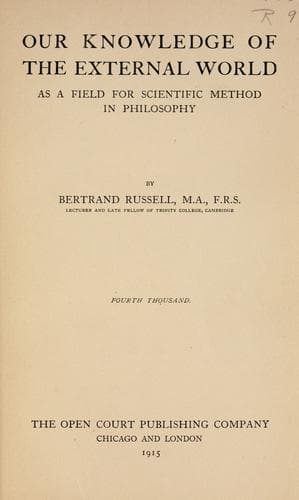
Our Knowledge of the External World as a Field for Scientific Method in PhilosophyRussell, Bertrand
Philosophy
Our Knowledge of the External World as a Field for Scientific Method in Philosophy
Russell, Bertrand
Knowledge, Theory of; Logical atomism
There is quite another direction in which a large technical development
of logic has taken place: I mean the direction of what is called
logistic or mathematical logic. This kind of logic is mathematical in
two different senses: it is itself a branch of mathematics, and it is
the logic which is specially applicable to other more traditional
branches of mathematics. Historically, it began as _merely_ a branch of
mathematics: its special applicability to other branches is a more
recent development. In both respects, it is the fulfilment of a hope
which Leibniz cherished throughout his life, and pursued with all the
ardour of his amazing intellectual energy. Much of his work on this
subject has been published recently, since his discoveries have been
remade by others; but none was published by him, because his results
persisted in contradicting certain points in the traditional doctrine of
the syllogism. We now know that on these points the traditional doctrine
is wrong, but respect for Aristotle prevented Leibniz from realising
that this was possible.[13]
[13] _Cf._ Couturat, _La Logique de Leibniz_, pp. 361, 386.
The modern development of mathematical logic dates from Boole's _Laws of
Thought_ (1854). But in him and his successors, before Peano and Frege,
the only thing really achieved, apart from certain details, was the
invention of a mathematical symbolism for deducing consequences from the
premisses which the newer methods shared with those of Aristotle. This
subject has considerable interest as an independent branch of
mathematics, but it has very little to do with real logic. The first
serious advance in real logic since the time of the Greeks was made
independently by Peano and Frege--both mathematicians. They both arrived
at their logical results by an analysis of mathematics. Traditional
logic regarded the two propositions, "Socrates is mortal" and "All men
are mortal," as being of the same form;[14] Peano and Frege showed that
they are utterly different in form. The philosophical importance of
logic may be illustrated by the fact that this confusion--which is still
committed by most writers--obscured not only the whole study of the
forms of judgment and inference, but also the relations of things to
their qualities, of concrete existence to abstract concepts, and of the
world of sense to the world of Platonic ideas. Peano and Frege, who
pointed out the error, did so for technical reasons, and applied their
logic mainly to technical developments; but the philosophical importance
of the advance which they made is impossible to exaggerate.
[14] It was often recognised that there was _some_ difference between
them, but it was not recognised that the difference is fundamental,
and of very great importance.
Public-domain text, read in full here on John Shaqi.
Reviews
Reviews
No reviews yet
Be the first to share your thoughts on this work.
Join the Discussion
Join the discussion
Sign in to leave a comment or review.
Sign InorCreate an account