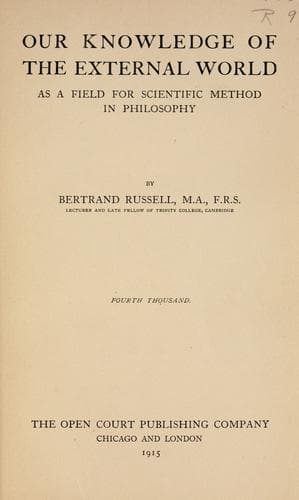
Our Knowledge of the External World as a Field for Scientific Method in PhilosophyRussell, Bertrand
Philosophy
Our Knowledge of the External World as a Field for Scientific Method in Philosophy
Russell, Bertrand
Knowledge, Theory of; Logical atomism
In all inference, form alone is essential: the particular subject-matter
is irrelevant except as securing the truth of the premisses. This is one
reason for the great importance of logical form. When I say, "Socrates
was a man, all men are mortal, therefore Socrates was mortal," the
connection of premisses and conclusion does not in any way depend upon
its being Socrates and man and mortality that I am mentioning. The
general form of the inference may be expressed in some such words as,
"If a thing has a certain property, and whatever has this property has a
certain other property, then the thing in question also has that other
property." Here no particular things or properties are mentioned: the
proposition is absolutely general. All inferences, when stated fully,
are instances of propositions having this kind of generality. If they
seem to depend upon the subject-matter otherwise than as regards the
truth of the premisses, that is because the premisses have not been all
explicitly stated. In logic, it is a waste of time to deal with
inferences concerning particular cases: we deal throughout with
completely general and purely formal implications, leaving it to other
sciences to discover when the hypotheses are verified and when they are
not.
But the forms of propositions giving rise to inferences are not the
simplest forms: they are always hypothetical, stating that if one
proposition is true, then so is another. Before considering inference,
therefore, logic must consider those simpler forms which inference
presupposes. Here the traditional logic failed completely: it believed
that there was only one form of simple proposition (_i.e._ of
proposition not stating a relation between two or more other
propositions), namely, the form which ascribes a predicate to a subject.
This is the appropriate form in assigning the qualities of a given
thing--we may say "this thing is round, and red, and so on." Grammar
favours this form, but philosophically it is so far from universal that
it is not even very common. If we say "this thing is bigger than that,"
we are not assigning a mere quality of "this," but a relation of "this"
and "that." We might express the same fact by saying "that thing is
smaller than this," where grammatically the subject is changed. Thus
propositions stating that two things have a certain relation have a
different form from subject-predicate propositions, and the failure to
perceive this difference or to allow for it has been the source of many
errors in traditional metaphysics.
Public-domain text, read in full here on John Shaqi.
Reviews
Reviews
No reviews yet
Be the first to share your thoughts on this work.
Join the Discussion
Join the discussion
Sign in to leave a comment or review.
Sign InorCreate an account