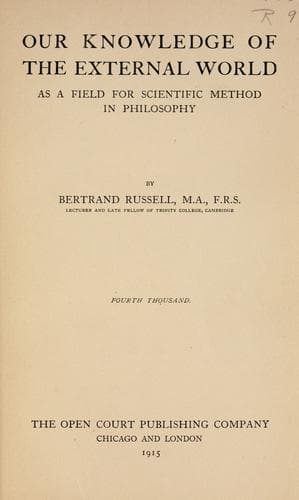
Our Knowledge of the External World as a Field for Scientific Method in PhilosophyRussell, Bertrand
Philosophy
Our Knowledge of the External World as a Field for Scientific Method in Philosophy
Russell, Bertrand
Knowledge, Theory of; Logical atomism
In every proposition and in every inference there is, besides the
particular subject-matter concerned, a certain _form_, a way in which
the constituents of the proposition or inference are put together. If I
say, "Socrates is mortal," "Jones is angry," "The sun is hot," there is
something in common in these three cases, something indicated by the
word "is." What is in common is the _form_ of the proposition, not an
actual constituent. If I say a number of things about Socrates--that he
was an Athenian, that he married Xantippe, that he drank the
hemlock--there is a common constituent, namely Socrates, in all the
propositions I enunciate, but they have diverse forms. If, on the other
hand, I take any one of these propositions and replace its constituents,
one at a time, by other constituents, the form remains constant, but no
constituent remains. Take (say) the series of propositions, "Socrates
drank the hemlock," "Coleridge drank the hemlock," "Coleridge drank
opium," "Coleridge ate opium." The form remains unchanged throughout
this series, but all the constituents are altered. Thus form is not
another constituent, but is the way the constituents are put together.
It is forms, in this sense, that are the proper object of philosophical
logic.
It is obvious that the knowledge of logical forms is something quite
different from knowledge of existing things. The form of "Socrates drank
the hemlock" is not an existing thing like Socrates or the hemlock, nor
does it even have that close relation to existing things that drinking
has. It is something altogether more abstract and remote. We might
understand all the separate words of a sentence without understanding
the sentence: if a sentence is long and complicated, this is apt to
happen. In such a case we have knowledge of the constituents, but not of
the form. We may also have knowledge of the form without having
knowledge of the constituents. If I say, "Rorarius drank the hemlock,"
those among you who have never heard of Rorarius (supposing there are
any) will understand the form, without having knowledge of all the
constituents. In order to understand a sentence, it is necessary to have
knowledge both of the constituents and of the particular instance of the
form. It is in this way that a sentence conveys information, since it
tells us that certain known objects are related according to a certain
known form. Thus some kind of knowledge of logical forms, though with
most people it is not explicit, is involved in all understanding of
discourse. It is the business of philosophical logic to extract this
knowledge from its concrete integuments, and to render it explicit and
pure.
Public-domain text, read in full here on John Shaqi.
Reviews
Reviews
No reviews yet
Be the first to share your thoughts on this work.
Join the Discussion
Join the discussion
Sign in to leave a comment or review.
Sign InorCreate an account