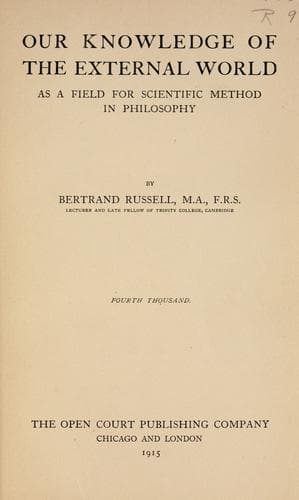
Our Knowledge of the External World as a Field for Scientific Method in PhilosophyRussell, Bertrand
Philosophy
Our Knowledge of the External World as a Field for Scientific Method in Philosophy
Russell, Bertrand
Knowledge, Theory of; Logical atomism
The logic of mysticism shows, as is natural, the defects which are
inherent in anything malicious. While the mystic mood is dominant, the
need of logic is not felt; as the mood fades, the impulse to logic
reasserts itself, but with a desire to retain the vanishing insight, or
at least to prove that it _was_ insight, and that what seems to
contradict it is illusion. The logic which thus arises is not quite
disinterested or candid, and is inspired by a certain hatred of the
daily world to which it is to be applied. Such an attitude naturally
does not tend to the best results. Everyone knows that to read an author
simply in order to refute him is not the way to understand him; and to
read the book of Nature with a conviction that it is all illusion is
just as unlikely to lead to understanding. If our logic is to find the
common world intelligible, it must not be hostile, but must be inspired
by a genuine acceptance such as is not usually to be found among
metaphysicians.
Traditional logic, since it holds that all propositions have the
subject-predicate form, is unable to admit the reality of relations: all
relations, it maintains, must be reduced to properties of the apparently
related terms. There are many ways of refuting this opinion; one of the
easiest is derived from the consideration of what are called
"asymmetrical" relations. In order to explain this, I will first explain
two independent ways of classifying relations.
Some relations, when they hold between A and B, also hold between B and
A. Such, for example, is the relation "brother or sister." If A is a
brother or sister of B, then B is a brother or sister of A. Such again
is any kind of similarity, say similarity of colour. Any kind of
dissimilarity is also of this kind: if the colour of A is unlike the
colour of B, then the colour of B is unlike the colour of A. Relations
of this sort are called _symmetrical_. Thus a relation is symmetrical
if, whenever it holds between A and B, it also holds between B and A.
All relations that are not symmetrical are called _non-symmetrical_.
Thus "brother" is non-symmetrical, because, if A is a brother of B, it
may happen that B is a _sister_ of A.
A relation is called _asymmetrical_ when, if it holds between A and B,
it _never_ holds between B and A. Thus husband, father, grandfather,
etc., are asymmetrical relations. So are _before_, _after_, _greater_,
_above_, _to the right of_, etc. All the relations that give rise to
series are of this kind.
Classification into symmetrical, asymmetrical, and merely
non-symmetrical relations is the first of the two classifications we had
to consider. The second is into transitive, intransitive, and merely
non-transitive relations, which are defined as follows.
Public-domain text, read in full here on John Shaqi.
Reviews
Reviews
No reviews yet
Be the first to share your thoughts on this work.
Join the Discussion
Join the discussion
Sign in to leave a comment or review.
Sign InorCreate an account