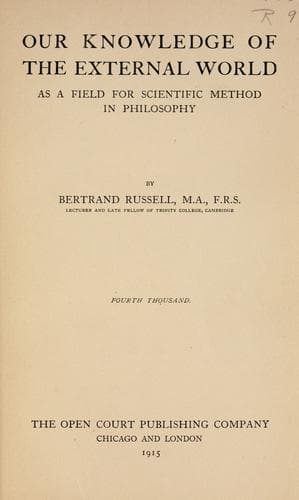
Our Knowledge of the External World as a Field for Scientific Method in Philosophy — John Shaqi
Our Knowledge of the External World as a Field for Scientific Method in PhilosophyRussell, Bertrand
Philosophy
Our Knowledge of the External World as a Field for Scientific Method in Philosophy
Russell, Bertrand
Knowledge, Theory of; Logical atomism
A relation is said to be _transitive_, if, whenever it holds between A
and B and also between B and C, it holds between A and C. Thus _before_,
_after_, _greater_, _above_ are transitive. All relations giving rise to
series are transitive, but so are many others. The transitive relations
just mentioned were asymmetrical, but many transitive relations are
symmetrical--for instance, equality in any respect, exact identity of
colour, being equally numerous (as applied to collections), and so on.
A relation is said to be _non-transitive_ whenever it is not transitive.
Thus "brother" is non-transitive, because a brother of one's brother may
be oneself. All kinds of dissimilarity are non-transitive.
A relation is said to be _intransitive_ when, if A has the relation to
B, and B to C, A never has it to C. Thus "father" is intransitive. So is
such a relation as "one inch taller" or "one year later."
Let us now, in the light of this classification, return to the question
whether all relations can be reduced to predications.
In the case of symmetrical relations--_i.e._ relations which, if they
hold between A and B, also hold between B and A--some kind of
plausibility can be given to this doctrine. A symmetrical relation which
is transitive, such as equality, can be regarded as expressing
possession of some common property, while one which is not transitive,
such as inequality, can be regarded as expressing possession of
different properties. But when we come to asymmetrical relations, such
as before and after, greater and less, etc., the attempt to reduce them
to properties becomes obviously impossible. When, for example, two
things are merely known to be unequal, without our knowing which is
greater, we may say that the inequality results from their having
different magnitudes, because inequality is a symmetrical relation; but
to say that when one thing is _greater_ than another, and not merely
unequal to it, that means that they have different magnitudes, is
formally incapable of explaining the facts. For if the other thing had
been greater than the one, the magnitudes would also have been
different, though the fact to be explained would not have been the same.
Thus mere _difference_ of magnitude is not _all_ that is involved,
since, if it were, there would be no difference between one thing being
greater than another, and the other being greater than the one. We shall
have to say that the one magnitude is _greater_ than the other, and thus
we shall have failed to get rid of the relation "greater." In short,
both possession of the same property and possession of different
properties are _symmetrical_ relations, and therefore cannot account for
the existence of _asymmetrical_ relations.
Public-domain text, read in full here on John Shaqi.
Reviews
Reviews
No reviews yet
Be the first to share your thoughts on this work.
Join the Discussion
Join the discussion
Sign in to leave a comment or review.
Sign InorCreate an account