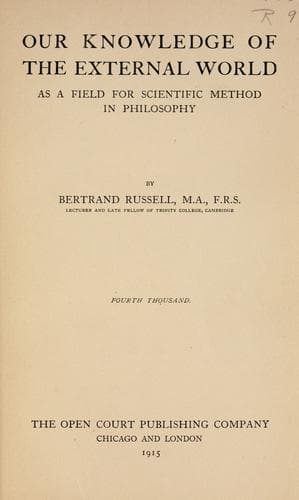
Our Knowledge of the External World as a Field for Scientific Method in PhilosophyRussell, Bertrand
Philosophy
Our Knowledge of the External World as a Field for Scientific Method in Philosophy
Russell, Bertrand
Knowledge, Theory of; Logical atomism
The existing world consists of many things with many qualities and
relations. A complete description of the existing world would require
not only a catalogue of the things, but also a mention of all their
qualities and relations. We should have to know not only this, that, and
the other thing, but also which was red, which yellow, which was earlier
than which, which was between which two others, and so on. When I speak
of a "fact," I do not mean one of the simple things in the world; I mean
that a certain thing has a certain quality, or that certain things have
a certain relation. Thus, for example, I should not call Napoleon a
fact, but I should call it a fact that he was ambitious, or that he
married Josephine. Now a fact, in this sense, is never simple, but
always has two or more constituents. When it simply assigns a quality to
a thing, it has only two constituents, the thing and the quality. When
it consists of a relation between two things, it has three constituents,
the things and the relation. When it consists of a relation between
three things, it has four constituents, and so on. The constituents of
facts, in the sense in which we are using the word "fact," are not other
facts, but are things and qualities or relations. When we say that there
are relations of more than two terms, we mean that there are single
facts consisting of a single relation and more than two things. I do not
mean that one relation of two terms may hold between A and B, and also
between A and C, as, for example, a man is the son of his father and
also the son of his mother. This constitutes two distinct facts: if we
choose to treat it as one fact, it is a fact which has facts for its
constituents. But the facts I am speaking of have no facts among their
constituents, but only things and relations. For example, when A is
jealous of B on account of C, there is only one fact, involving three
people; there are not two instances of jealousy, but only one. It is in
such cases that I speak of a relation of three terms, where the simplest
possible fact in which the relation occurs is one involving three things
in addition to the relation. And the same applies to relations of four
terms or five or any other number. All such relations must be admitted
in our inventory of the logical forms of facts: two facts involving the
same number of things have the same form, and two which involve
different numbers of things have different forms.
Public-domain text, read in full here on John Shaqi.
Reviews
Reviews
No reviews yet
Be the first to share your thoughts on this work.
Join the Discussion
Join the discussion
Sign in to leave a comment or review.
Sign InorCreate an account