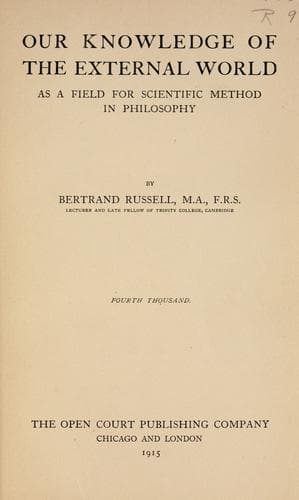
Our Knowledge of the External World as a Field for Scientific Method in PhilosophyRussell, Bertrand
Philosophy
Our Knowledge of the External World as a Field for Scientific Method in Philosophy
Russell, Bertrand
Knowledge, Theory of; Logical atomism
Asymmetrical relations are involved in all series--in space and time,
greater and less, whole and part, and many others of the most important
characteristics of the actual world. All these aspects, therefore, the
logic which reduces everything to subjects and predicates is compelled
to condemn as error and mere appearance. To those whose logic is not
malicious, such a wholesale condemnation appears impossible. And in fact
there is no reason except prejudice, so far as I can discover, for
denying the reality of relations. When once their reality is admitted,
all _logical_ grounds for supposing the world of sense to be illusory
disappear. If this is to be supposed, it must be frankly and simply on
the ground of mystic insight unsupported by argument. It is impossible
to argue against what professes to be insight, so long as it does not
argue in its own favour. As logicians, therefore, we may admit the
possibility of the mystic's world, while yet, so long as we do not have
his insight, we must continue to study the everyday world with which we
are familiar. But when he contends that our world is impossible, then
our logic is ready to repel his attack. And the first step in creating
the logic which is to perform this service is the recognition of the
reality of relations.
Relations which have two terms are only one kind of relations. A
relation may have three terms, or four, or any number. Relations of two
terms, being the simplest, have received more attention than the others,
and have generally been alone considered by philosophers, both those who
accepted and those who denied the reality of relations. But other
relations have their importance, and are indispensable in the solution
of certain problems. Jealousy, for example, is a relation between three
people. Professor Royce mentions the relation "giving": when A gives B
to C, that is a relation of three terms.[15] When a man says to his
wife: "My dear, I wish you could induce Angelina to accept Edwin," his
wish constitutes a relation between four people, himself, his wife,
Angelina, and Edwin. Thus such relations are by no means recondite or
rare. But in order to explain exactly how they differ from relations of
two terms, we must embark upon a classification of the logical forms of
facts, which is the first business of logic, and the business in which
the traditional logic has been most deficient.
[15] _Encyclopædia of the Philosophical Sciences_, vol. i. p. 97.
Public-domain text, read in full here on John Shaqi.
Reviews
Reviews
No reviews yet
Be the first to share your thoughts on this work.
Join the Discussion
Join the discussion
Sign in to leave a comment or review.
Sign InorCreate an account