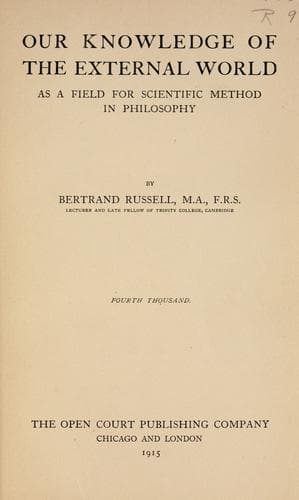
Our Knowledge of the External World as a Field for Scientific Method in PhilosophyRussell, Bertrand
Philosophy
Our Knowledge of the External World as a Field for Scientific Method in Philosophy
Russell, Bertrand
Knowledge, Theory of; Logical atomism
Among present-day philosophies, we may distinguish three principal
types, often combined in varying proportions by a single philosopher,
but in essence and tendency distinct. The first of these, which I shall
call the classical tradition, descends in the main from Kant and Hegel;
it represents the attempt to adapt to present needs the methods and
results of the great constructive philosophers from Plato downwards. The
second type, which may be called evolutionism, derived its predominance
from Darwin, and must be reckoned as having had Herbert Spencer for its
first philosophical representative; but in recent times it has become,
chiefly through William James and M. Bergson, far bolder and far more
searching in its innovations than it was in the hands of Herbert
Spencer. The third type, which may be called "logical atomism" for want
of a better name, has gradually crept into philosophy through the
critical scrutiny of mathematics. This type of philosophy, which is the
one that I wish to advocate, has not as yet many whole-hearted
adherents, but the "new realism" which owes its inception to Harvard is
very largely impregnated with its spirit. It represents, I believe, the
same kind of advance as was introduced into physics by Galileo: the
substitution of piecemeal, detailed, and verifiable results for large
untested generalities recommended only by a certain appeal to
imagination. But before we can understand the changes advocated by this
new philosophy, we must briefly examine and criticise the other two
types with which it has to contend.
A. The Classical Tradition
Twenty years ago, the classical tradition, having vanquished the
opposing tradition of the English empiricists, held almost unquestioned
sway in all Anglo-Saxon universities. At the present day, though it is
losing ground, many of the most prominent teachers still adhere to it.
In academic France, in spite of M. Bergson, it is far stronger than all
its opponents combined; and in Germany it has many vigorous advocates.
Nevertheless, it represents on the whole a decaying force, and it has
failed to adapt itself to the temper of the age. Its advocates are, in
the main, those whose extra-philosophical knowledge is literary, rather
than those who have felt the inspiration of science. There are, apart
from reasoned arguments, certain general intellectual forces against
it--the same general forces which are breaking down the other great
syntheses of the past, and making our age one of bewildered groping
where our ancestors walked in the clear daylight of unquestioning
certainty.
Public-domain text, read in full here on John Shaqi.
Reviews
Reviews
No reviews yet
Be the first to share your thoughts on this work.
Join the Discussion
Join the discussion
Sign in to leave a comment or review.
Sign InorCreate an account