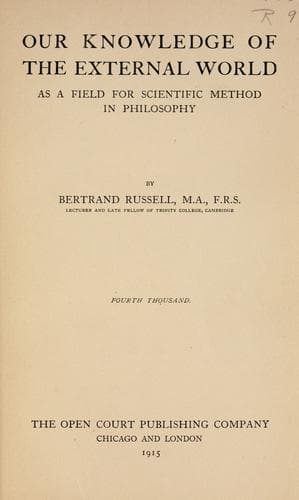
Our Knowledge of the External World as a Field for Scientific Method in PhilosophyRussell, Bertrand
Philosophy
Our Knowledge of the External World as a Field for Scientific Method in Philosophy
Russell, Bertrand
Knowledge, Theory of; Logical atomism
The original impulse out of which the classical tradition developed was
the naïve faith of the Greek philosophers in the omnipotence of
reasoning. The discovery of geometry had intoxicated them, and its _a
priori_ deductive method appeared capable of universal application. They
would prove, for instance, that all reality is one, that there is no
such thing as change, that the world of sense is a world of mere
illusion; and the strangeness of their results gave them no qualms
because they believed in the correctness of their reasoning. Thus it
came to be thought that by mere thinking the most surprising and
important truths concerning the whole of reality could be established
with a certainty which no contrary observations could shake. As the
vital impulse of the early philosophers died away, its place was taken
by authority and tradition, reinforced, in the Middle Ages and almost to
our own day, by systematic theology. Modern philosophy, from Descartes
onwards, though not bound by authority like that of the Middle Ages,
still accepted more or less uncritically the Aristotelian logic.
Moreover, it still believed, except in Great Britain, that _a priori_
reasoning could reveal otherwise undiscoverable secrets about the
universe, and could prove reality to be quite different from what, to
direct observation, it appears to be. It is this belief, rather than any
particular tenets resulting from it, that I regard as the distinguishing
characteristic of the classical tradition, and as hitherto the main
obstacle to a scientific attitude in philosophy.
The nature of the philosophy embodied in the classical tradition may be
made clearer by taking a particular exponent as an illustration. For
this purpose, let us consider for a moment the doctrines of Mr Bradley,
who is probably the most distinguished living representative of this
school. Mr Bradley's _Appearance and Reality_ is a book consisting of
two parts, the first called _Appearance_, the second _Reality_. The
first part examines and condemns almost all that makes up our everyday
world: things and qualities, relations, space and time, change,
causation, activity, the self. All these, though in some sense facts
which qualify reality, are not real as they appear. What is real is one
single, indivisible, timeless whole, called the Absolute, which is in
some sense spiritual, but does not consist of souls, or of thought and
will as we know them. And all this is established by abstract logical
reasoning professing to find self-contradictions in the categories
condemned as mere appearance, and to leave no tenable alternative to the
kind of Absolute which is finally affirmed to be real.
Public-domain text, read in full here on John Shaqi.
Reviews
Reviews
No reviews yet
Be the first to share your thoughts on this work.
Join the Discussion
Join the discussion
Sign in to leave a comment or review.
Sign InorCreate an account