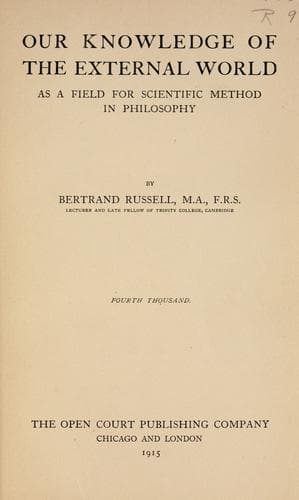
Our Knowledge of the External World as a Field for Scientific Method in Philosophy — John Shaqi
Our Knowledge of the External World as a Field for Scientific Method in PhilosophyRussell, Bertrand
Philosophy
Our Knowledge of the External World as a Field for Scientific Method in Philosophy
Russell, Bertrand
Knowledge, Theory of; Logical atomism
When we were discussing atomic facts, we saw that we should be able,
theoretically, to infer all other truths by logic if we knew all atomic
facts and also knew that there were no other atomic facts besides those
we knew. The knowledge that there are no other atomic facts is positive
general knowledge; it is the knowledge that "all atomic facts are known
to me," or at least "all atomic facts are in this collection"--however
the collection may be given. It is easy to see that general
propositions, such as "all men are mortal," cannot be known by inference
from atomic facts alone. If we could know each individual man, and know
that he was mortal, that would not enable us to know that all men are
mortal, unless we _knew_ that those were all the men there are, which is
a general proposition. If we knew every other existing thing throughout
the universe, and knew that each separate thing was not an immortal man,
that would not give us our result unless we _knew_ that we had explored
the whole universe, _i.e._ unless we knew "all things belong to this
collection of things I have examined." Thus general truths cannot be
inferred from particular truths alone, but must, if they are to be
known, be either self-evident, or inferred from premisses of which at
least one is a general truth. But all _empirical_ evidence is of
_particular_ truths. Hence, if there is any knowledge of general truths
at all, there must be _some_ knowledge of general truths which is
independent of empirical evidence, _i.e._ does not depend upon the data
of sense.
The above conclusion, of which we had an instance in the case of the
inductive principle, is important, since it affords a refutation of the
older empiricists. They believed that all our knowledge is derived from
the senses and dependent upon them. We see that, if this view is to be
maintained, we must refuse to admit that we know any general
propositions. It is perfectly possible logically that this should be the
case, but it does not appear to be so in fact, and indeed no one would
dream of maintaining such a view except a theorist at the last
extremity. We must therefore admit that there is general knowledge not
derived from sense, and that some of this knowledge is not obtained by
inference but is primitive.
Public-domain text, read in full here on John Shaqi.
Reviews
Reviews
No reviews yet
Be the first to share your thoughts on this work.
Join the Discussion
Join the discussion
Sign in to leave a comment or review.
Sign InorCreate an account