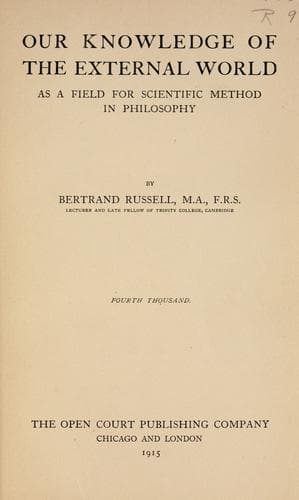
Our Knowledge of the External World as a Field for Scientific Method in PhilosophyRussell, Bertrand
Philosophy
Our Knowledge of the External World as a Field for Scientific Method in Philosophy
Russell, Bertrand
Knowledge, Theory of; Logical atomism
Such general knowledge is to be found in logic. Whether there is any
such knowledge not derived from logic, I do not know; but in logic, at
any rate, we have such knowledge. It will be remembered that we excluded
from pure logic such propositions as, "Socrates is a man, all men are
mortal, therefore Socrates is mortal," because Socrates and _man_ and
_mortal_ are empirical terms, only to be understood through particular
experience. The corresponding proposition in pure logic is: "If anything
has a certain property, and whatever has this property has a certain
other property, then the thing in question has the other property." This
proposition is absolutely general: it applies to all things and all
properties. And it is quite self-evident. Thus in such propositions of
pure logic we have the self-evident general propositions of which we
were in search.
A proposition such as, "If Socrates is a man, and all men are mortal,
then Socrates is mortal," is true in virtue of its _form_ alone. Its
truth, in this hypothetical form, does not depend upon whether Socrates
actually is a man, nor upon whether in fact all men are mortal; thus it
is equally true when we substitute other terms for Socrates and _man_
and _mortal_. The general truth of which it is an instance is purely
formal, and belongs to logic. Since it does not mention any particular
thing, or even any particular quality or relation, it is wholly
independent of the accidental facts of the existent world, and can be
known, theoretically, without any experience of particular things or
their qualities and relations.
Logic, we may say, consists of two parts. The first part investigates
what propositions are and what forms they may have; this part enumerates
the different kinds of atomic propositions, of molecular propositions,
of general propositions, and so on. The second part consists of certain
supremely general propositions, which assert the truth of all
propositions of certain forms. This second part merges into pure
mathematics, whose propositions all turn out, on analysis, to be such
general formal truths. The first part, which merely enumerates forms, is
the more difficult, and philosophically the more important; and it is
the recent progress in this first part, more than anything else, that
has rendered a truly scientific discussion of many philosophical
problems possible.
Public-domain text, read in full here on John Shaqi.
Reviews
Reviews
No reviews yet
Be the first to share your thoughts on this work.
Join the Discussion
Join the discussion
Sign in to leave a comment or review.
Sign InorCreate an account