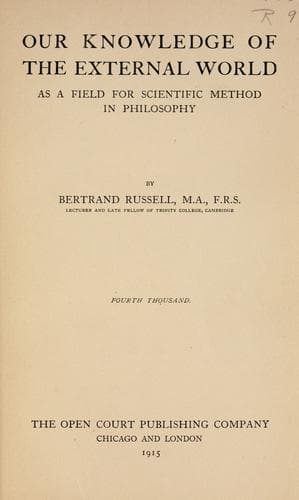
Our Knowledge of the External World as a Field for Scientific Method in PhilosophyRussell, Bertrand
Philosophy
Our Knowledge of the External World as a Field for Scientific Method in Philosophy
Russell, Bertrand
Knowledge, Theory of; Logical atomism
Philosophy may be approached by many roads, but one of the oldest and
most travelled is the road which leads through doubt as to the reality
of the world of sense. In Indian mysticism, in Greek and modern monistic
philosophy from Parmenides onward, in Berkeley, in modern physics, we
find sensible appearance criticised and condemned for a bewildering
variety of motives. The mystic condemns it on the ground of immediate
knowledge of a more real and significant world behind the veil;
Parmenides and Plato condemn it because its continual flux is thought
inconsistent with the unchanging nature of the abstract entities
revealed by logical analysis; Berkeley brings several weapons, but his
chief is the subjectivity of sense-data, their dependence upon the
organisation and point of view of the spectator; while modern physics,
on the basis of sensible evidence itself, maintains a mad dance of
electrons which has, superficially at least, very little resemblance to
the immediate objects of sight or touch.
Every one of these lines of attack raises vital and interesting
problems.
The mystic, so long as he merely reports a positive revelation, cannot
be refuted; but when he _denies_ reality to objects of sense, he may be
questioned as to what he means by "reality," and may be asked how their
unreality follows from the supposed reality of his super-sensible world.
In answering these questions, he is led to a logic which merges into
that of Parmenides and Plato and the idealist tradition.
The logic of the idealist tradition has gradually grown very complex and
very abstruse, as may be seen from the Bradleian sample considered in
our first lecture. If we attempted to deal fully with this logic, we
should not have time to reach any other aspect of our subject; we will
therefore, while acknowledging that it deserves a long discussion, pass
by its central doctrines with only such occasional criticism as may
serve to exemplify other topics, and concentrate our attention on such
matters as its objections to the continuity of motion and the infinity
of space and time--objections which have been fully answered by modern
mathematicians in a manner constituting an abiding triumph for the
method of logical analysis in philosophy. These objections and the
modern answers to them will occupy our fifth, sixth, and seventh
lectures.
Berkeley's attack, as reinforced by the physiology of the sense-organs
and nerves and brain, is very powerful. I think it must be admitted as
probable that the immediate objects of sense depend for their existence
upon physiological conditions in ourselves, and that, for example, the
coloured surfaces which we see cease to exist when we shut our eyes. But
it would be a mistake to infer that they are dependent upon mind, not
real while we see them, or not the sole basis for our knowledge of the
external world. This line of argument will be developed in the present
lecture.
Public-domain text, read in full here on John Shaqi.
Reviews
Reviews
No reviews yet
Be the first to share your thoughts on this work.
Join the Discussion
Join the discussion
Sign in to leave a comment or review.
Sign InorCreate an account