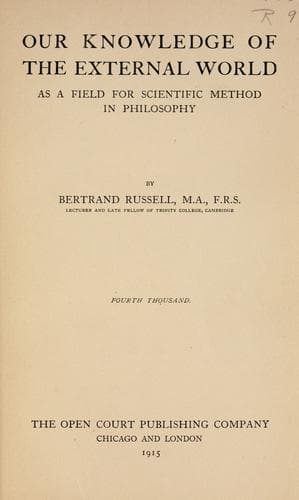
Our Knowledge of the External World as a Field for Scientific Method in PhilosophyRussell, Bertrand
Philosophy
Our Knowledge of the External World as a Field for Scientific Method in Philosophy
Russell, Bertrand
Knowledge, Theory of; Logical atomism
The problem of the nature of judgment or belief may be taken as an
example of a problem whose solution depends upon an adequate inventory
of logical forms. We have already seen how the supposed universality of
the subject-predicate form made it impossible to give a right analysis
of serial order, and therefore made space and time unintelligible. But
in this case it was only necessary to admit relations of two terms. The
case of judgment demands the admission of more complicated forms. If all
judgments were true, we might suppose that a judgment consisted in
apprehension of a _fact_, and that the apprehension was a relation of a
mind to the fact. From poverty in the logical inventory, this view has
often been held. But it leads to absolutely insoluble difficulties in
the case of error. Suppose I believe that Charles I. died in his bed.
There is no objective fact "Charles I.'s death in his bed" to which I
can have a relation of apprehension. Charles I. and death and his bed
are objective, but they are not, except in my thought, put together as
my false belief supposes. It is therefore necessary, in analysing a
belief, to look for some other logical form than a two-term relation.
Failure to realise this necessity has, in my opinion, vitiated almost
everything that has hitherto been written on the theory of knowledge,
making the problem of error insoluble and the difference between belief
and perception inexplicable.
Modern logic, as I hope is now evident, has the effect of enlarging our
abstract imagination, and providing an infinite number of possible
hypotheses to be applied in the analysis of any complex fact. In this
respect it is the exact opposite of the logic practised by the classical
tradition. In that logic, hypotheses which seem _primâ facie_ possible
are professedly proved impossible, and it is decreed in advance that
reality must have a certain special character. In modern logic, on the
contrary, while the _primâ facie_ hypotheses as a rule remain
admissible, others, which only logic would have suggested, are added to
our stock, and are very often found to be indispensable if a right
analysis of the facts is to be obtained. The old logic put thought in
fetters, while the new logic gives it wings. It has, in my opinion,
introduced the same kind of advance into philosophy as Galileo
introduced into physics, making it possible at last to see what kinds of
problems may be capable of solution, and what kinds must be abandoned as
beyond human powers. And where a solution appears possible, the new
logic provides a method which enables us to obtain results that do not
merely embody personal idiosyncrasies, but must command the assent of
all who are competent to form an opinion.
LECTURE III
ON OUR KNOWLEDGE OF THE EXTERNAL WORLD
Public-domain text, read in full here on John Shaqi.
Reviews
Reviews
No reviews yet
Be the first to share your thoughts on this work.
Join the Discussion
Join the discussion
Sign in to leave a comment or review.
Sign InorCreate an account