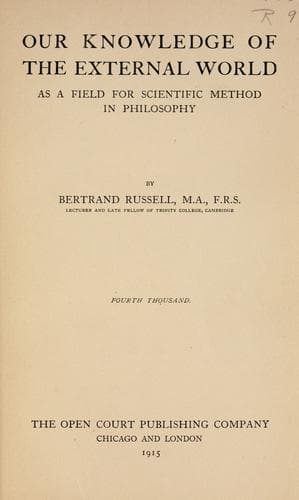
Our Knowledge of the External World as a Field for Scientific Method in Philosophy — John Shaqi
Our Knowledge of the External World as a Field for Scientific Method in PhilosophyRussell, Bertrand
Philosophy
Our Knowledge of the External World as a Field for Scientific Method in Philosophy
Russell, Bertrand
Knowledge, Theory of; Logical atomism
We are thus led to a somewhat vague distinction between what we may call
"hard" data and "soft" data. This distinction is a matter of degree, and
must not be pressed; but if not taken too seriously it may help to make
the situation clear. I mean by "hard" data those which resist the
solvent influence of critical reflection, and by "soft" data those
which, under the operation of this process, become to our minds more or
less doubtful. The hardest of hard data are of two sorts: the particular
facts of sense, and the general truths of logic. The more we reflect
upon these, the more we realise exactly what they are, and exactly what
a doubt concerning them really means, the more luminously certain do
they become. _Verbal_ doubt concerning even these is possible, but
verbal doubt may occur when what is nominally being doubted is not
really in our thoughts, and only words are actually present to our
minds. Real doubt, in these two cases, would, I think, be pathological.
At any rate, to me they seem quite certain, and I shall assume that you
agree with me in this. Without this assumption, we are in danger of
falling into that universal scepticism which, as we saw, is as barren as
it is irrefutable. If we are to continue philosophising, we must make
our bow to the sceptical hypothesis, and, while admitting the elegant
terseness of its philosophy, proceed to the consideration of other
hypotheses which, though perhaps not certain, have at least as good a
right to our respect as the hypothesis of the sceptic.
Applying our distinction of "hard" and "soft" data to psychologically
derivative but logically primitive beliefs, we shall find that most, if
not all, are to be classed as soft data. They may be found, on
reflection, to be capable of logical proof, and they then again become
believed, but no longer as data. As data, though entitled to a certain
limited respect, they cannot be placed on a level with the facts of
sense or the laws of logic. The kind of respect which they deserve seems
to me such as to warrant us in hoping, though not too confidently, that
the hard data may prove them to be at least probable. Also, if the hard
data are found to throw no light whatever upon their truth or falsehood,
we are justified, I think, in giving rather more weight to the
hypothesis of their truth than to the hypothesis of their falsehood. For
the present, however, let us confine ourselves to the hard data, with a
view to discovering what sort of world can be constructed by their means
alone.
Public-domain text, read in full here on John Shaqi.
Reviews
Reviews
No reviews yet
Be the first to share your thoughts on this work.
Join the Discussion
Join the discussion
Sign in to leave a comment or review.
Sign InorCreate an account