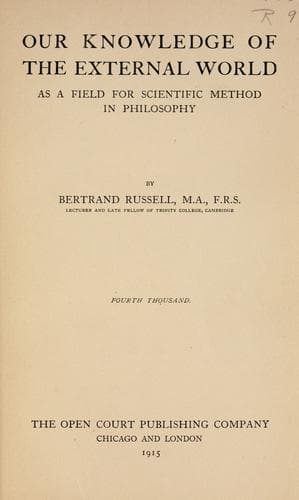
Our Knowledge of the External World as a Field for Scientific Method in PhilosophyRussell, Bertrand
Philosophy
Our Knowledge of the External World as a Field for Scientific Method in Philosophy
Russell, Bertrand
Knowledge, Theory of; Logical atomism
Let us now endeavour to state the fact that the aspect which a thing
presents at a given place is affected by the intervening medium. The
aspects of a thing in different perspectives are to be conceived as
spreading outwards from the place where the thing is, and undergoing
various changes as they get further away from this place. The laws
according to which they change cannot be stated if we only take account
of the aspects that are near the thing, but require that we should also
take account of the things that are at the places from which these
aspects appear. This empirical fact can, therefore, be interpreted in
terms of our construction.
We have now constructed a largely hypothetical picture of the world,
which contains and places the experienced facts, including those derived
from testimony. The world we have constructed can, with a certain amount
of trouble, be used to interpret the crude facts of sense, the facts of
physics, and the facts of physiology. It is therefore a world which
_may_ be actual. It fits the facts, and there is no empirical evidence
against it; it also is free from logical impossibilities. But have we
any good reason to suppose that it is real? This brings us back to our
original problem, as to the grounds for believing in the existence of
anything outside my private world. What we have derived from our
hypothetical construction is that there are no grounds _against_ the
truth of this belief, but we have not derived any positive grounds in
its favour. We will resume this inquiry by taking up again the question
of testimony and the evidence for the existence of other minds.
It must be conceded to begin with that the argument in favour of the
existence of other people's minds cannot be conclusive. A phantasm of
our dreams will appear to have a mind--a mind to be annoying, as a rule.
It will give unexpected answers, refuse to conform to our desires, and
show all those other signs of intelligence to which we are accustomed in
the acquaintances of our waking hours. And yet, when we are awake, we do
not believe that the phantasm was, like the appearances of people in
waking life, representative of a private world to which we have no
direct access. If we are to believe this of the people we meet when we
are awake, it must be on some ground short of demonstration, since it is
obviously possible that what we call waking life may be only an
unusually persistent and recurrent nightmare. It may be that our
imagination brings forth all that other people seem to say to us, all
that we read in books, all the daily, weekly, monthly, and quarterly
journals that distract our thoughts, all the advertisements of soap and
all the speeches of politicians. This _may_ be true, since it cannot be
shown to be false, yet no one can really believe it. Is there any
_logical_ ground for regarding this possibility as improbable? Or is
there nothing beyond habit and prejudice?
Public-domain text, read in full here on John Shaqi.
Reviews
Reviews
No reviews yet
Be the first to share your thoughts on this work.
Elsewhere in the archive
Join the Discussion
Join the discussion
Sign in to leave a comment or review.
Sign InorCreate an account