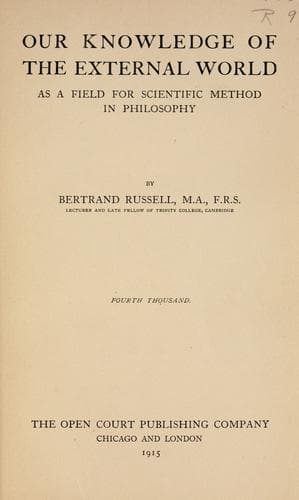
Our Knowledge of the External World as a Field for Scientific Method in PhilosophyRussell, Bertrand
Philosophy
Our Knowledge of the External World as a Field for Scientific Method in Philosophy
Russell, Bertrand
Knowledge, Theory of; Logical atomism
The minds of other people are among our data, in the very wide sense in
which we used the word at first. That is to say, when we first begin to
reflect, we find ourselves already believing in them, not because of any
argument, but because the belief is natural to us. It is, however, a
psychologically derivative belief, since it results from observation of
people's bodies; and along with other such beliefs, it does not belong
to the hardest of hard data, but becomes, under the influence of
philosophic reflection, just sufficiently questionable to make us desire
some argument connecting it with the facts of sense.
The obvious argument is, of course, derived from analogy. Other people's
bodies behave as ours do when we have certain thoughts and feelings;
hence, by analogy, it is natural to suppose that such behaviour is
connected with thoughts and feelings like our own. Someone says, "Look
out!" and we find we are on the point of being killed by a motor-car; we
therefore attribute the words we heard to the person in question having
seen the motor-car first, in which case there are existing things of
which we are not directly conscious. But this whole scene, with our
inference, may occur in a dream, in which case the inference is
generally considered to be mistaken. Is there anything to make the
argument from analogy more cogent when we are (as we think) awake?
The analogy in waking life is only to be preferred to that in dreams on
the ground of its greater extent and consistency. If a man were to dream
every night about a set of people whom he never met by day, who had
consistent characters and grew older with the lapse of years, he might,
like the man in Calderon's play, find it difficult to decide which was
the dream-world and which was the so-called "real" world. It is only the
failure of our dreams to form a consistent whole either with each other
or with waking life that makes us condemn them. Certain uniformities are
observed in waking life, while dreams seem quite erratic. The natural
hypothesis would be that demons and the spirits of the dead visit us
while we sleep; but the modern mind, as a rule, refuses to entertain
this view, though it is hard to see what could be said against it. On
the other hand, the mystic, in moments of illumination, seems to awaken
from a sleep which has filled all his mundane life: the whole world of
sense becomes phantasmal, and he sees, with the clarity and
convincingness that belongs to our morning realisation after dreams, a
world utterly different from that of our daily cares and troubles. Who
shall condemn him? Who shall justify him? Or who shall justify the
seeming solidity of the common objects among which we suppose ourselves
to live?
Public-domain text, read in full here on John Shaqi.
Reviews
Reviews
No reviews yet
Be the first to share your thoughts on this work.
Elsewhere in the archive
Join the Discussion
Join the discussion
Sign in to leave a comment or review.
Sign InorCreate an account