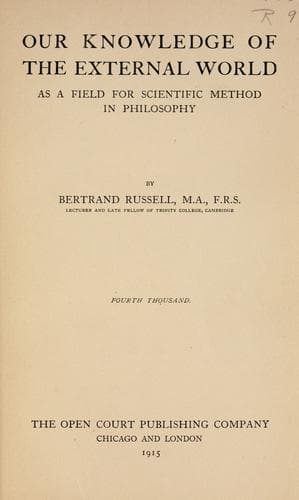
Our Knowledge of the External World as a Field for Scientific Method in PhilosophyRussell, Bertrand
Philosophy
Our Knowledge of the External World as a Field for Scientific Method in Philosophy
Russell, Bertrand
Knowledge, Theory of; Logical atomism
The hypothesis that other people have minds must, I think, be allowed to
be not susceptible of any very strong support from the analogical
argument. At the same time, it is a hypothesis which systematises a vast
body of facts and never leads to any consequences which there is reason
to think false. There is therefore nothing to be said against its truth,
and good reason to use it as a working hypothesis. When once it is
admitted, it enables us to extend our knowledge of the sensible world by
testimony, and thus leads to the system of private worlds which we
assumed in our hypothetical construction. In actual fact, whatever we
may try to think as philosophers, we cannot help believing in the minds
of other people, so that the question whether our belief is justified
has a merely speculative interest. And if it is justified, then there is
no further difficulty of principle in that vast extension of our
knowledge, beyond our own private data, which we find in science and
common sense.
This somewhat meagre conclusion must not be regarded as the whole
outcome of our long discussion. The problem of the connection of sense
with objective reality has commonly been dealt with from a standpoint
which did not carry initial doubt so far as we have carried it; most
writers, consciously or unconsciously, have assumed that the testimony
of others is to be admitted, and therefore (at least by implication)
that others have minds. Their difficulties have arisen after this
admission, from the differences in the appearance which one physical
object presents to two people at the same time, or to one person at two
times between which it cannot be supposed to have changed. Such
difficulties have made people doubtful how far objective reality could
be known by sense at all, and have made them suppose that there were
positive arguments against the view that it can be so known. Our
hypothetical construction meets these arguments, and shows that the
account of the world given by common sense and physical science can be
interpreted in a way which is logically unobjectionable, and finds a
place for all the data, both hard and soft. It is this hypothetical
construction, with its reconciliation of psychology and physics, which
is the chief outcome of our discussion. Probably the construction is
only in part necessary as an initial assumption, and can be obtained
from more slender materials by the logical methods of which we shall
have an example in the definitions of points, instants, and particles;
but I do not yet know to what lengths this diminution in our initial
assumptions can be carried.
LECTURE IV
THE WORLD OF PHYSICS AND THE WORLD OF SENSE
Public-domain text, read in full here on John Shaqi.
Reviews
Reviews
No reviews yet
Be the first to share your thoughts on this work.
Elsewhere in the archive
Join the Discussion
Join the discussion
Sign in to leave a comment or review.
Sign InorCreate an account