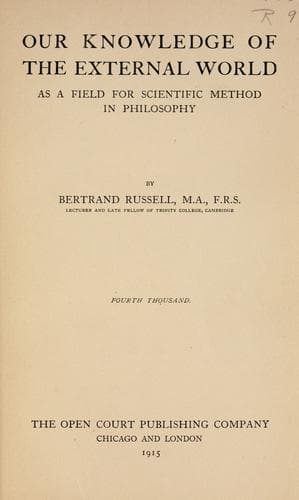
Our Knowledge of the External World as a Field for Scientific Method in PhilosophyRussell, Bertrand
Philosophy
Our Knowledge of the External World as a Field for Scientific Method in Philosophy
Russell, Bertrand
Knowledge, Theory of; Logical atomism
Among the objections to the reality of objects of sense, there is one
which is derived from the apparent difference between matter as it
appears in physics and things as they appear in sensation. Men of
science, for the most part, are willing to condemn immediate data as
"merely subjective," while yet maintaining the truth of the physics
inferred from those data. But such an attitude, though it may be
_capable_ of justification, obviously stands in need of it; and the only
justification possible must be one which exhibits matter as a logical
construction from sense-data--unless, indeed, there were some wholly _a
priori_ principle by which unknown entities could be inferred from such
as are known. It is therefore necessary to find some way of bridging the
gulf between the world of physics and the world of sense, and it is this
problem which will occupy us in the present lecture. Physicists appear
to be unconscious of the gulf, while psychologists, who are conscious of
it, have not the mathematical knowledge required for spanning it. The
problem is difficult, and I do not know its solution in detail. All that
I can hope to do is to make the problem felt, and to indicate the kind
of methods by which a solution is to be sought.
Let us begin by a brief description of the two contrasted worlds. We
will take first the world of physics, for, though the other world is
given while the physical world is inferred, to us now the world of
physics is the more familiar, the world of pure sense having become
strange and difficult to rediscover. Physics started from the
common-sense belief in fairly permanent and fairly rigid bodies--tables
and chairs, stones, mountains, the earth and moon and sun. This
common-sense belief, it should be noticed, is a piece of audacious
metaphysical theorising; objects are not continually present to
sensation, and it may be doubted whether they are there when they are
not seen or felt. This problem, which has been acute since the time of
Berkeley, is ignored by common sense, and has therefore hitherto been
ignored by physicists. We have thus here a first departure from the
immediate data of sensation, though it is a departure merely by way of
extension, and was probably made by our savage ancestors in some very
remote prehistoric epoch.
Public-domain text, read in full here on John Shaqi.
Reviews
Reviews
No reviews yet
Be the first to share your thoughts on this work.
Elsewhere in the archive
Join the Discussion
Join the discussion
Sign in to leave a comment or review.
Sign InorCreate an account