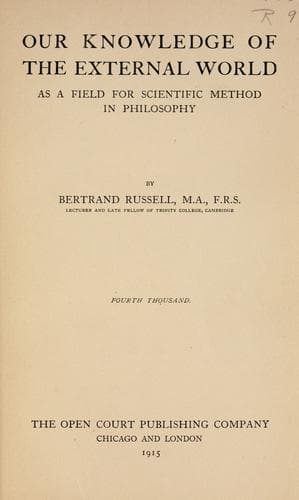
Our Knowledge of the External World as a Field for Scientific Method in PhilosophyRussell, Bertrand
Philosophy
Our Knowledge of the External World as a Field for Scientific Method in Philosophy
Russell, Bertrand
Knowledge, Theory of; Logical atomism
But tables and chairs, stones and mountains, are not _quite_ permanent
or _quite_ rigid. Tables and chairs lose their legs, stones are split by
frost, and mountains are cleft by earthquakes and eruptions. Then there
are other things, which seem material, and yet present almost no
permanence or rigidity. Breath, smoke, clouds, are examples of such
things--so, in a lesser degree, are ice and snow; and rivers and seas,
though fairly permanent, are not in any degree rigid. Breath, smoke,
clouds, and generally things that can be seen but not touched, were
thought to be hardly real; to this day the usual mark of a ghost is that
it can be seen but not touched. Such objects were peculiar in the fact
that they seemed to disappear completely, not merely to be transformed
into something else. Ice and snow, when they disappear, are replaced by
water; and it required no great theoretical effort to invent the
hypothesis that the water was the same thing as the ice and snow, but in
a new form. Solid bodies, when they break, break into parts which are
practically the same in shape and size as they were before. A stone can
be hammered into a powder, but the powder consists of grains which
retain the character they had before the pounding. Thus the ideal of
absolutely rigid and absolutely permanent bodies, which early physicists
pursued throughout the changing appearances, seemed attainable by
supposing ordinary bodies to be composed of a vast number of tiny atoms.
This billiard-ball view of matter dominated the imagination of
physicists until quite modern times, until, in fact, it was replaced by
the electromagnetic theory, which in its turn is developing into a new
atomism. Apart from the special form of the atomic theory which was
invented for the needs of chemistry, some kind of atomism dominated the
whole of traditional dynamics, and was implied in every statement of its
laws and axioms.
Public-domain text, read in full here on John Shaqi.
Reviews
Reviews
No reviews yet
Be the first to share your thoughts on this work.
Elsewhere in the archive
Join the Discussion
Join the discussion
Sign in to leave a comment or review.
Sign InorCreate an account