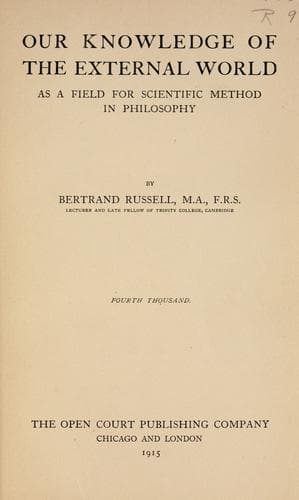
Our Knowledge of the External World as a Field for Scientific Method in PhilosophyRussell, Bertrand
Philosophy
Our Knowledge of the External World as a Field for Scientific Method in Philosophy
Russell, Bertrand
Knowledge, Theory of; Logical atomism
The pictorial accounts which physicists give of the material world as
they conceive it undergo violent changes under the influence of
modifications in theory which are much slighter than the layman might
suppose from the alterations of the description. Certain features,
however, have remained fairly stable. It is always assumed that there is
_something_ indestructible which is capable of motion in space; what is
indestructible is always very small, but does not always occupy a mere
point in space. There is supposed to be one all-embracing space in which
the motion takes place, and until lately we might have assumed one
all-embracing time also. But the principle of relativity has given
prominence to the conception of "local time," and has somewhat
diminished men's confidence in the one even-flowing stream of time.
Without dogmatising as to the ultimate outcome of the principle of
relativity, however, we may safely say, I think, that it does not
destroy the possibility of correlating different local times, and does
not therefore have such far-reaching philosophical consequences as is
sometimes supposed. In fact, in spite of difficulties as to measurement,
the one all-embracing time still, I think, underlies all that physics
has to say about motion. We thus have still in physics, as we had in
Newton's time, a set of indestructible entities which may be called
particles, moving relatively to each other in a single space and a
single time.
The world of immediate data is quite different from this. Nothing is
permanent; even the things that we think are fairly permanent, such as
mountains, only become data when we see them, and are not immediately
given as existing at other moments. So far from one all-embracing space
being given, there are several spaces for each person, according to the
different senses which give relations that may be called spatial.
Experience teaches us to obtain one space from these by correlation, and
experience, together with instinctive theorising, teaches us to
correlate our spaces with those which we believe to exist in the
sensible worlds of other people. The construction of a single time
offers less difficulty so long as we confine ourselves to one person's
private world, but the correlation of one private time with another is a
matter of great difficulty. Thus, apart from any of the fluctuating
hypotheses of physics, three main problems arise in connecting the world
of physics with the world of sense, namely (1) the construction of
permanent "things," (2) the construction of a single space, and (3) the
construction of a single time. We will consider these three problems in
succession.
Public-domain text, read in full here on John Shaqi.
Reviews
Reviews
No reviews yet
Be the first to share your thoughts on this work.
Elsewhere in the archive
Join the Discussion
Join the discussion
Sign in to leave a comment or review.
Sign InorCreate an account