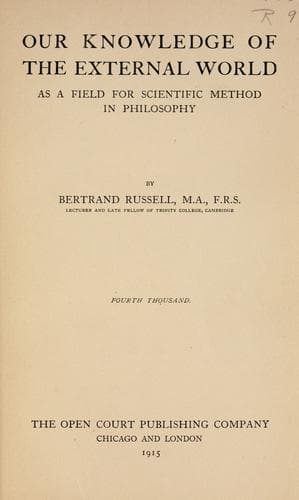
Our Knowledge of the External World as a Field for Scientific Method in PhilosophyRussell, Bertrand
Philosophy
Our Knowledge of the External World as a Field for Scientific Method in Philosophy
Russell, Bertrand
Knowledge, Theory of; Logical atomism
(1) The belief in indestructible "things" very early took the form of
atomism. The underlying motive in atomism was not, I think, any
empirical success in interpreting phenomena, but rather an instinctive
belief that beneath all the changes of the sensible world there must be
something permanent and unchanging. This belief was, no doubt, fostered
and nourished by its practical successes, culminating in the
conservation of mass; but it was not produced by these successes. On the
contrary, they were produced by it. Philosophical writers on physics
sometimes speak as though the conservation of something or other were
essential to the possibility of science, but this, I believe, is an
entirely erroneous opinion. If the _a priori_ belief in permanence had
not existed, the same laws which are now formulated in terms of this
belief might just as well have been formulated without it. Why should we
suppose that, when ice melts, the water which replaces it is the same
thing in a new form? Merely because this supposition enables us to state
the phenomena in a way which is consonant with our prejudices. What we
really know is that, under certain conditions of temperature, the
appearance we call ice is replaced by the appearance we call water. We
can give laws according to which the one appearance will be succeeded by
the other, but there is no reason except prejudice for regarding both as
appearances of the same substance.
One task, if what has just been said is correct, which confronts us in
trying to connect the world of sense with the world of physics, is the
task of reconstructing the conception of matter without the _a priori_
beliefs which historically gave rise to it. In spite of the
revolutionary results of modern physics, the empirical successes of the
conception of matter show that there must be some legitimate conception
which fulfils roughly the same functions. The time has hardly come when
we can state precisely what this legitimate conception is, but we can
see in a general way what it must be like. For this purpose, it is only
necessary to take our ordinary common-sense statements and reword them
without the assumption of permanent substance. We say, for example, that
things change gradually--sometimes very quickly, but not without passing
through a continuous series of intermediate states. What this means is
that, given any sensible appearance, there will usually be, _if we
watch_, a continuous series of appearances connected with the given one,
leading on by imperceptible gradations to the new appearances which
common-sense regards as those of the same thing. Thus a thing may be
defined as a certain series of appearances, connected with each other by
continuity and by certain causal laws. In the case of slowly changing
things, this is easily seen. Consider, say, a wall-paper which fades in
the course of years. It is an effort not to conceive of it as one
"thing" whose colour is slightly different at one time from what it is
at another.
Public-domain text, read in full here on John Shaqi.
Reviews
Reviews
No reviews yet
Be the first to share your thoughts on this work.
Elsewhere in the archive
Join the Discussion
Join the discussion
Sign in to leave a comment or review.
Sign InorCreate an account