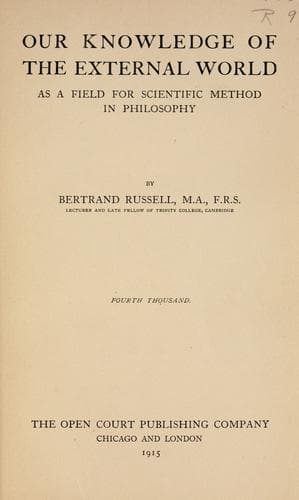
Our Knowledge of the External World as a Field for Scientific Method in PhilosophyRussell, Bertrand
Philosophy
Our Knowledge of the External World as a Field for Scientific Method in Philosophy
Russell, Bertrand
Knowledge, Theory of; Logical atomism
But what do we really _know_ about it? We know that under
suitable circumstances--_i.e._ when we are, as is said, "in the
room"--we perceive certain colours in a certain pattern: not always
precisely the same colours, but sufficiently similar to feel familiar.
If we can state the laws according to which the colour varies, we can
state all that is empirically verifiable; the assumption that there is a
constant entity, the wall-paper, which "has" these various colours at
various times, is a piece of gratuitous metaphysics. We may, if we like,
_define_ the wall-paper as the series of its aspects. These are
collected together by the same motives which led us to regard the
wall-paper as one thing, namely a combination of sensible continuity and
causal connection. More generally, a "thing" will be defined as a
certain series of aspects, namely those which would commonly be said to
be _of_ the thing. To say that a certain aspect is an aspect _of_ a
certain thing will merely mean that it is one of those which, taken
serially, _are_ the thing. Everything will then proceed as before:
whatever was verifiable is unchanged, but our language is so interpreted
as to avoid an unnecessary metaphysical assumption of permanence.
The above extrusion of permanent things affords an example of the maxim
which inspires all scientific philosophising, namely "Occam's razor":
_Entities are not to be multiplied without necessity._ In other words,
in dealing with any subject-matter, find out what entities are
undeniably involved, and state everything in terms of these entities.
Very often the resulting statement is more complicated and difficult
than one which, like common sense and most philosophy, assumes
hypothetical entities whose existence there is no good reason to believe
in. We find it easier to imagine a wall-paper with changing colours than
to think merely of the series of colours; but it is a mistake to suppose
that what is easy and natural in thought is what is most free from
unwarrantable assumptions, as the case of "things" very aptly
illustrates.
The above summary account of the genesis of "things," though it may be
correct in outline, has omitted some serious difficulties which it is
necessary briefly to consider. Starting from a world of helter-skelter
sense-data, we wish to collect them into series, each of which can be
regarded as consisting of the successive appearances of one "thing."
There is, to begin with, some conflict between what common sense regards
as one thing, and what physics regards an unchanging collection of
particles. To common sense, a human body is one thing, but to science
the matter composing it is continually changing. This conflict, however,
is not very serious, and may, for our rough preliminary purpose, be
largely ignored. The problem is: by what principles shall we select
certain data from the chaos, and call them all appearances of the same
thing?
Public-domain text, read in full here on John Shaqi.
Reviews
Reviews
No reviews yet
Be the first to share your thoughts on this work.
Elsewhere in the archive
Join the Discussion
Join the discussion
Sign in to leave a comment or review.
Sign InorCreate an account