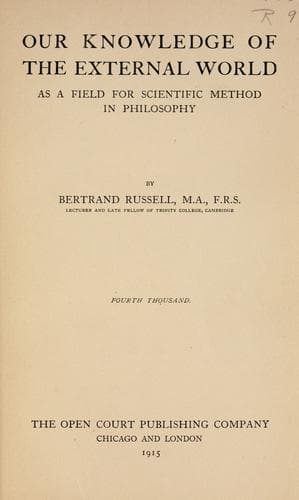
Our Knowledge of the External World as a Field for Scientific Method in PhilosophyRussell, Bertrand
Philosophy
Our Knowledge of the External World as a Field for Scientific Method in Philosophy
Russell, Bertrand
Knowledge, Theory of; Logical atomism
A rough and approximate answer to this question is not very difficult.
There are certain fairly stable collections of appearances, such as
landscapes, the furniture of rooms, the faces of acquaintances. In these
cases, we have little hesitation in regarding them on successive
occasions as appearances of one thing or collection of things. But, as
the _Comedy of Errors_ illustrates, we may be led astray if we judge by
mere resemblance. This shows that something more is involved, for two
different things may have any degree of likeness up to exact similarity.
Another insufficient criterion of one thing is _continuity_. As we have
already seen, if we watch what we regard as one changing thing, we
usually find its changes to be continuous so far as our senses can
perceive. We are thus led to assume that, if we see two finitely
different appearances at two different times, and if we have reason to
regard them as belonging to the same thing, then there was a continuous
series of intermediate states of that thing during the time when we were
not observing it. And so it comes to be thought that continuity of
change is necessary and sufficient to constitute one thing. But in fact
it is neither. It is not _necessary_, because the unobserved states, in
the case where our attention has not been concentrated on the thing
throughout, are purely hypothetical, and cannot possibly be our ground
for supposing the earlier and later appearances to belong to the same
thing; on the contrary, it is because we suppose this that we assume
intermediate unobserved states. Continuity is also not sufficient, since
we can, for example, pass by sensibly continuous gradations from any one
drop of the sea to any other drop. The utmost we can say is that
discontinuity during uninterrupted observation is as a rule a mark of
difference between things, though even this cannot be said in such cases
as sudden explosions.
The assumption of continuity is, however, successfully made in physics.
This proves something, though not anything of very obvious utility to
our present problem: it proves that nothing in the known world is
inconsistent with the hypothesis that all changes are really continuous,
though from too great rapidity or from our lack of observation they may
not always appear continuous. In this hypothetical sense, continuity may
be allowed to be a _necessary_ condition if two appearances are to be
classed as appearances of the same thing. But it is not a _sufficient_
condition, as appears from the instance of the drops in the sea. Thus
something more must be sought before we can give even the roughest
definition of a "thing."
Public-domain text, read in full here on John Shaqi.
Reviews
Reviews
No reviews yet
Be the first to share your thoughts on this work.
Elsewhere in the archive
Join the Discussion
Join the discussion
Sign in to leave a comment or review.
Sign InorCreate an account