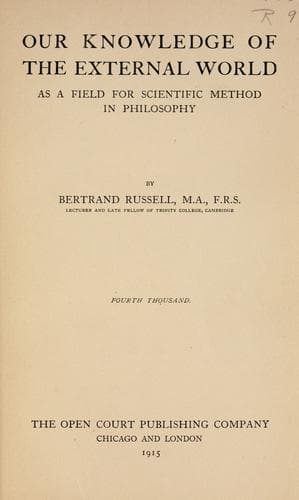
Our Knowledge of the External World as a Field for Scientific Method in PhilosophyRussell, Bertrand
Philosophy
Our Knowledge of the External World as a Field for Scientific Method in Philosophy
Russell, Bertrand
Knowledge, Theory of; Logical atomism
What is wanted further seems to be something in the nature of fulfilment
of causal laws. This statement, as it stands, is very vague, but we will
endeavour to give it precision. When I speak of "causal laws," I mean
any laws which connect events at different times, or even, as a limiting
case, events at the same time provided the connection is not logically
demonstrable. In this very general sense, the laws of dynamics are
causal laws, and so are the laws correlating the simultaneous
appearances of one "thing" to different senses. The question is: How do
such laws help in the definition of a "thing"?
To answer this question, we must consider what it is that is proved by
the empirical success of physics. What is proved is that its hypotheses,
though unverifiable where they go beyond sense-data, are at no point in
contradiction with sense-data, but, on the contrary, are ideally such as
to render all sense-data calculable from a sufficient collection of data
all belonging to a given period of time. Now physics has found it
empirically possible to collect sense-data into series, each series
being regarded as belonging to one "thing," and behaving, with regard to
the laws of physics, in a way in which series not belonging to one thing
would in general not behave. If it is to be unambiguous whether two
appearances belong to the same thing or not, there must be only one way
of grouping appearances so that the resulting things obey the laws of
physics. It would be very difficult to prove that this is the case, but
for our present purposes we may let this point pass, and assume that
there is only one way. We must include in our definition of a "thing"
those of its aspects, if any, which are not observed. Thus we may lay
down the following definition: _Things are those series of aspects which
obey the laws of physics._ That such series exist is an empirical fact,
which constitutes the verifiability of physics.
It may still be objected that the "matter" of physics is something other
than series of sense-data. Sense-data, it may be said, belong to
psychology and are, at any rate in some sense, subjective, whereas
physics is quite independent of psychological considerations, and does
not assume that its matter only exists when it is perceived.
To this objection there are two answers, both of some importance.
Public-domain text, read in full here on John Shaqi.
Reviews
Reviews
No reviews yet
Be the first to share your thoughts on this work.
Elsewhere in the archive
Join the Discussion
Join the discussion
Sign in to leave a comment or review.
Sign InorCreate an account