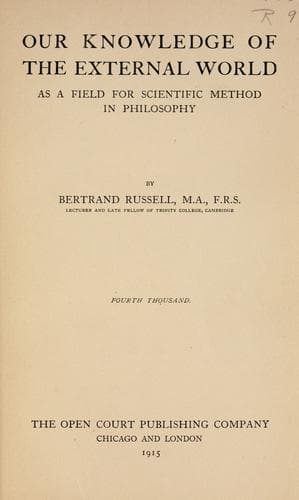
Our Knowledge of the External World as a Field for Scientific Method in PhilosophyRussell, Bertrand
Philosophy
Our Knowledge of the External World as a Field for Scientific Method in Philosophy
Russell, Bertrand
Knowledge, Theory of; Logical atomism
(a) We have been considering, in the above account, the question of the
_verifiability_ of physics. Now verifiability is by no means the same
thing as truth; it is, in fact, something far more subjective and
psychological. For a proposition to be verifiable, it is not enough that
it should be true, but it must also be such as we can _discover_ to be
true. Thus verifiability depends upon our capacity for acquiring
knowledge, and not only upon the objective truth. In physics, as
ordinarily set forth, there is much that is unverifiable: there are
hypotheses as to (α) how things would appear to a spectator in a place
where, as it happens, there is no spectator; (β) how things would appear
at times when, in fact, they are not appearing to anyone; (γ) things
which never appear at all. All these are introduced to simplify the
statement of the causal laws, but none of them form an integral part of
what is _known_ to be true in physics. This brings us to our second
answer.
(b) If physics is to consist wholly of propositions known to be true, or
at least capable of being proved or disproved, the three kinds of
hypothetical entities we have just enumerated must all be capable of
being exhibited as logical functions of sense-data. In order to show how
this might possibly be done, let us recall the hypothetical Leibnizian
universe of Lecture III. In that universe, we had a number of
perspectives, two of which never had any entity in common, but often
contained entities which could be sufficiently correlated to be regarded
as belonging to the same thing. We will call one of these an "actual"
private world when there is an actual spectator to which it appears, and
"ideal" when it is merely constructed on principles of continuity. A
physical thing consists, at each instant, of the whole set of its
aspects at that instant, in all the different worlds; thus a momentary
state of a thing is a whole set of aspects. An "ideal" appearance will
be an aspect merely calculated, but not actually perceived by any
spectator. An "ideal" state of a thing will be a state at a moment when
all its appearances are ideal. An ideal thing will be one whose states
at all times are ideal. Ideal appearances, states, and things, since
they are calculated, must be functions of actual appearances, states,
and things; in fact, ultimately, they must be functions of actual
appearances. Thus it is unnecessary, for the enunciation of the laws of
physics, to assign any reality to ideal elements: it is enough to accept
them as logical constructions, provided we have means of knowing how to
determine when they become actual. This, in fact, we have with some
degree of approximation; the starry heaven, for instance, becomes actual
whenever we choose to look at it. It is open to us to believe that the
ideal elements exist, and there can be no reason for _dis_believing
this; but unless in virtue of some _a priori_ law we cannot _know_ it,
Public-domain text, read in full here on John Shaqi.
Reviews
Reviews
No reviews yet
Be the first to share your thoughts on this work.
Elsewhere in the archive
Join the Discussion
Join the discussion
Sign in to leave a comment or review.
Sign InorCreate an account