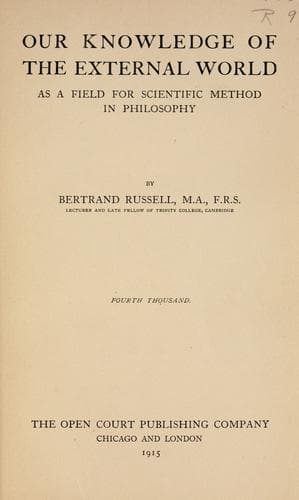
Our Knowledge of the External World as a Field for Scientific Method in PhilosophyRussell, Bertrand
Philosophy
Our Knowledge of the External World as a Field for Scientific Method in Philosophy
Russell, Bertrand
Knowledge, Theory of; Logical atomism
for empirical knowledge is confined to what we actually observe.
(2) The three main conceptions of physics are space, time, and matter.
Some of the problems raised by the conception of matter have been
indicated in the above discussion of "things." But space and time also
raise difficult problems of much the same kind, namely, difficulties in
reducing the haphazard untidy world of immediate sensation to the smooth
orderly world of geometry and kinematics. Let us begin with the
consideration of space.
People who have never read any psychology seldom realise how much mental
labour has gone into the construction of the one all-embracing space
into which all sensible objects are supposed to fit. Kant, who was
unusually ignorant of psychology, described space as "an infinite given
whole," whereas a moment's psychological reflection shows that a space
which is infinite is not given, while a space which can be called given
is not infinite. What the nature of "given" space really is, is a
difficult question, upon which psychologists are by no means agreed. But
some general remarks may be made, which will suffice to show the
problems, without taking sides on any psychological issue still in
debate.
The first thing to notice is that different senses have different
spaces. The space of sight is quite different from the space of touch:
it is only by experience in infancy that we learn to correlate them. In
later life, when we see an object within reach, we know how to touch it,
and more or less what it will feel like; if we touch an object with our
eyes shut, we know where we should have to look for it, and more or less
what it would look like. But this knowledge is derived from early
experience of the correlation of certain kinds of touch-sensations with
certain kinds of sight-sensations. The one space into which both kinds
of sensations fit is an intellectual construction, not a datum. And
besides touch and sight, there are other kinds of sensation which give
other, though less important spaces: these also have to be fitted into
the one space by means of experienced correlations. And as in the case
of things, so here: the one all-embracing space, though convenient as a
way of speaking, need not be supposed really to exist. All that
experience makes certain is the several spaces of the several senses,
correlated by empirically discovered laws. The one space may turn out to
be valid as a logical construction, compounded of the several spaces,
but there is no good reason to assume its independent metaphysical
reality.
Public-domain text, read in full here on John Shaqi.
Reviews
Reviews
No reviews yet
Be the first to share your thoughts on this work.
Elsewhere in the archive
Join the Discussion
Join the discussion
Sign in to leave a comment or review.
Sign InorCreate an account