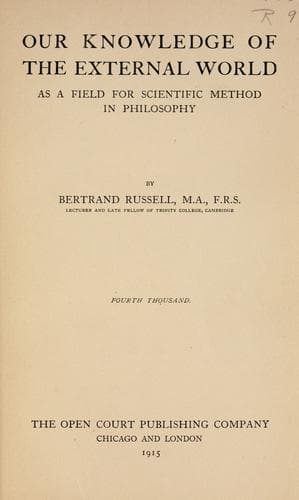
Our Knowledge of the External World as a Field for Scientific Method in PhilosophyRussell, Bertrand
Philosophy
Our Knowledge of the External World as a Field for Scientific Method in Philosophy
Russell, Bertrand
Knowledge, Theory of; Logical atomism
Another respect in which the spaces of immediate experience differ from
the space of geometry and physics is in regard to _points_. The space of
geometry and physics consists of an infinite number of points, but no
one has ever seen or touched a point. If there are points in a sensible
space, they must be an inference. It is not easy to see any way in
which, as independent entities, they could be validly inferred from the
data; thus here again, we shall have, if possible, to find some logical
construction, some complex assemblage of immediately given objects,
which will have the geometrical properties required of points. It is
customary to think of points as simple and infinitely small, but
geometry in no way demands that we should think of them in this way. All
that is necessary for geometry is that they should have mutual relations
possessing certain enumerated abstract properties, and it may be that an
assemblage of data of sensation will serve this purpose. Exactly how
this is to be done, I do not yet know, but it seems fairly certain that
it can be done.
The following illustrative method, simplified so as to be easily
manipulated, has been invented by Dr Whitehead for the purpose of
showing how points might be manufactured from sense-data. We have first
of all to observe that there are no infinitesimal sense-data: any
surface we can see, for example, must be of some finite extent. But what
at first appears as one undivided whole is often found, under the
influence of attention, to split up into parts contained within the
whole. Thus one spatial object may be contained within another, and
entirely enclosed by the other. This relation of enclosure, by the help
of some very natural hypotheses, will enable us to define a "point" as a
certain class of spatial objects, namely all those (as it will turn out
in the end) which would naturally be said to contain the point. In order
to obtain a definition of a "point" in this way, we proceed as follows:
Public-domain text, read in full here on John Shaqi.
Reviews
Reviews
No reviews yet
Be the first to share your thoughts on this work.
Elsewhere in the archive
Join the Discussion
Join the discussion
Sign in to leave a comment or review.
Sign InorCreate an account