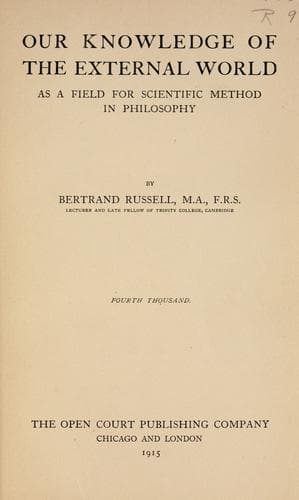
Our Knowledge of the External World as a Field for Scientific Method in PhilosophyRussell, Bertrand
Philosophy
Our Knowledge of the External World as a Field for Scientific Method in Philosophy
Russell, Bertrand
Knowledge, Theory of; Logical atomism
When a point or an instant is defined as a class of sensible qualities,
the first impression produced is likely to be one of wild and wilful
paradox. Certain considerations apply here, however, which will again be
relevant when we come to the definition of numbers. There is a whole
type of problems which can be solved by such definitions, and almost
always there will be at first an effect of paradox. Given a set of
objects any two of which have a relation of the sort called "symmetrical
and transitive," it is almost certain that we shall come to regard them
as all having some common quality, or as all having the same relation to
some one object outside the set. This kind of case is important, and I
shall therefore try to make it clear even at the cost of some repetition
of previous definitions.
A relation is said to be "symmetrical" when, if one term has this
relation to another, then the other also has it to the one. Thus
"brother or sister" is a "symmetrical" relation: if one person is a
brother or a sister of another, then the other is a brother or sister of
the one. Simultaneity, again, is a symmetrical relation; so is equality
in size. A relation is said to be "transitive" when, if one term has
this relation to another, and the other to a third, then the one has it
to the third. The symmetrical relations mentioned just now are also
transitive--provided, in the case of "brother or sister," we allow a
person to be counted as his or her own brother or sister, and provided,
in the case of simultaneity, we mean complete simultaneity, _i.e._
beginning and ending together.
But many relations are transitive without being symmetrical--for
instance, such relations as "greater," "earlier," "to the right of,"
"ancestor of," in fact all such relations as give rise to series. Other
relations are symmetrical without being transitive--for example,
difference in any respect. If A is of a different age from B, and B of a
different age from C, it does not follow that A is of a different age
from C. Simultaneity, again, in the case of events which last for a
finite time, will not necessarily be transitive if it only means that
the times of the two events overlap. If A ends just after B has begun,
and B ends just after C has begun, A and B will be simultaneous in this
sense, and so will B and C, but A and C may well not be simultaneous.
Public-domain text, read in full here on John Shaqi.
Reviews
Reviews
No reviews yet
Be the first to share your thoughts on this work.
Elsewhere in the archive
Join the Discussion
Join the discussion
Sign in to leave a comment or review.
Sign InorCreate an account