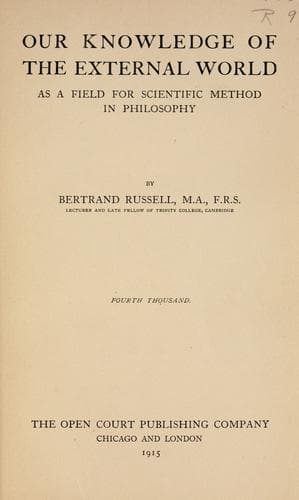
Our Knowledge of the External World as a Field for Scientific Method in PhilosophyRussell, Bertrand
Philosophy
Our Knowledge of the External World as a Field for Scientific Method in Philosophy
Russell, Bertrand
Knowledge, Theory of; Logical atomism
All the relations which can naturally be represented as equality in any
respect, or as possession of a common property, are transitive and
symmetrical--this applies, for example, to such relations as being of
the same height or weight or colour. Owing to the fact that possession
of a common property gives rise to a transitive symmetrical relation, we
come to imagine that wherever such a relation occurs it must be due to a
common property. "Being equally numerous" is a transitive symmetrical
relation of two collections; hence we imagine that both have a common
property, called their number. "Existing at a given instant" (in the
sense in which we defined an instant) is a transitive symmetrical
relation; hence we come to think that there really is an instant which
confers a common property on all the things existing at that instant.
"Being states of a given thing" is a transitive symmetrical relation;
hence we come to imagine that there really is a thing, other than the
series of states, which accounts for the transitive symmetrical
relation. In all such cases, the class of terms that have the given
transitive symmetrical relation to a given term will fulfil all the
formal requisites of a common property of all the members of the class.
Since there certainly is the class, while any other common property may
be illusory, it is prudent, in order to avoid needless assumptions, to
substitute the class for the common property which would be ordinarily
assumed. This is the reason for the definitions we have adopted, and
this is the source of the apparent paradoxes. No harm is done if there
are such common properties as language assumes, since we do not deny
them, but merely abstain from asserting them. But if there are not such
common properties in any given case, then our method has secured us
against error. In the absence of special knowledge, therefore, the
method we have adopted is the only one which is safe, and which avoids
the risk of introducing fictitious metaphysical entities.
LECTURE V
THE THEORY OF CONTINUITY
Public-domain text, read in full here on John Shaqi.
Reviews
Reviews
No reviews yet
Be the first to share your thoughts on this work.
Elsewhere in the archive
Join the Discussion
Join the discussion
Sign in to leave a comment or review.
Sign InorCreate an account